



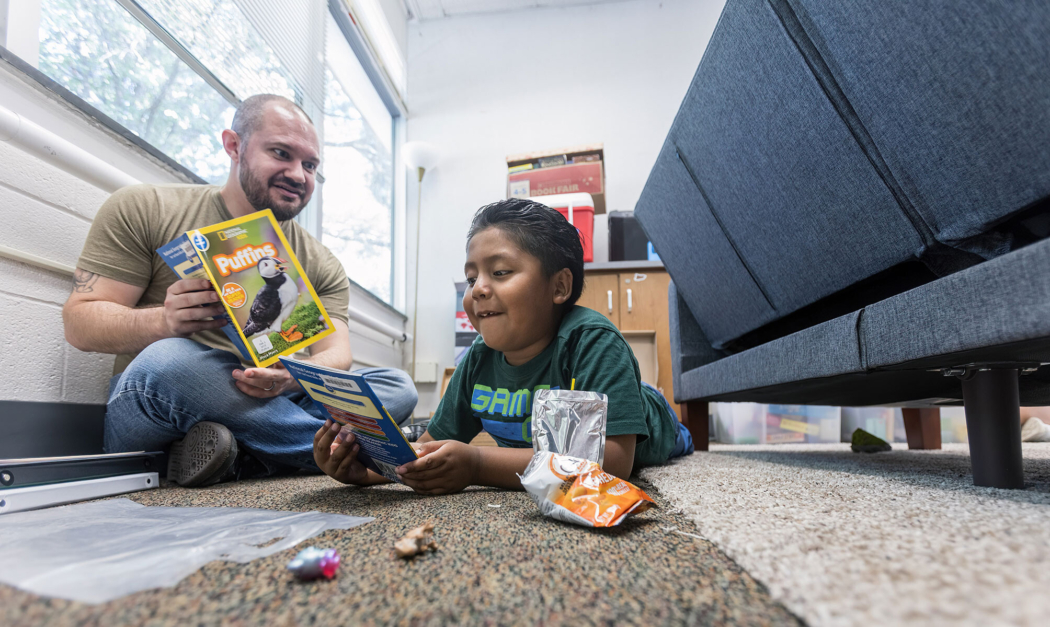
What would your life be like if you had never learned to read?
Sit with that question for a moment. Think about your job, your independence, the last text you received, the menu from your last dinner out, the legal contract you signed, the book on your nightstand. Now imagine if all those things were off limits to you. Imagine being a child sitting in a classroom, surrounded by words that don’t yet make sense and wondering if they ever will.
Then think about coming home to an empty refrigerator.
For almost 20 years, Read and Feed has been answering that question one child, one book, and one meal at a time.
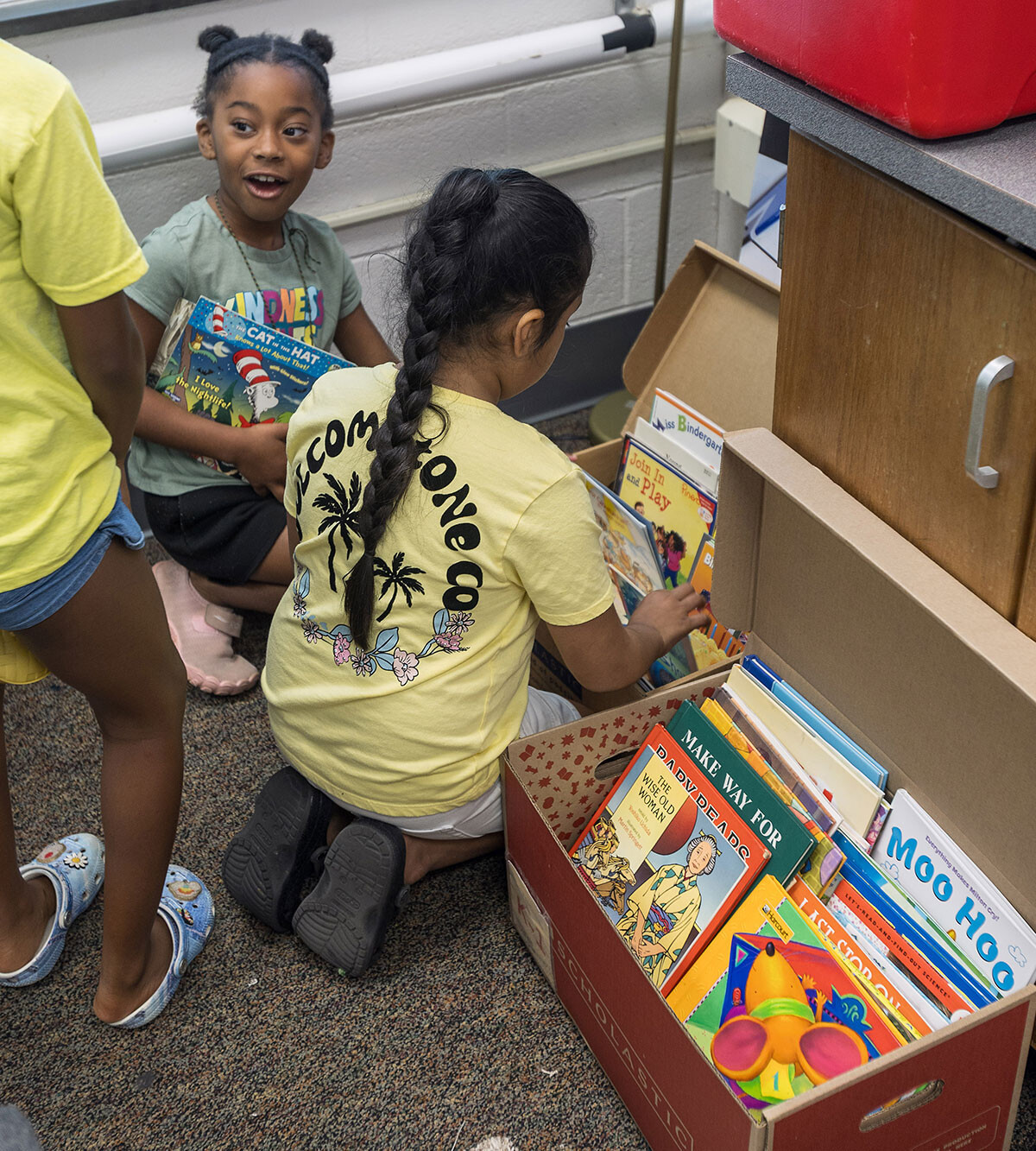
Children select the books they want to read each session, as well as self-selecting between 80 and 100 books over the course of the year to keep.
The numbers make the urgency clear. In Wake County, 42% of students rely on free or reduced meals. Also consider that 33.4% of Wake County students in third grade, a critical academic milestone, didn’t demonstrate reading proficiency during the 2024–2025 academic year.
“Think about those children growing up,” says Read and Feed’s executive director Sherry Overton Shudra, “and if they don’t improve that proficiency level, becoming adults that need to participate in the workforce. … That impacts everyone.”
Read and Feed’s story begins with a woman named Jan France, the organization’s founder, who started volunteering in local schools. What she found was a web of barriers — children who couldn’t stay after school because they had to catch a bus, families with one car and one working parent, neighborhoods where the nearest library felt impossibly far. And underneath all of that was hunger.
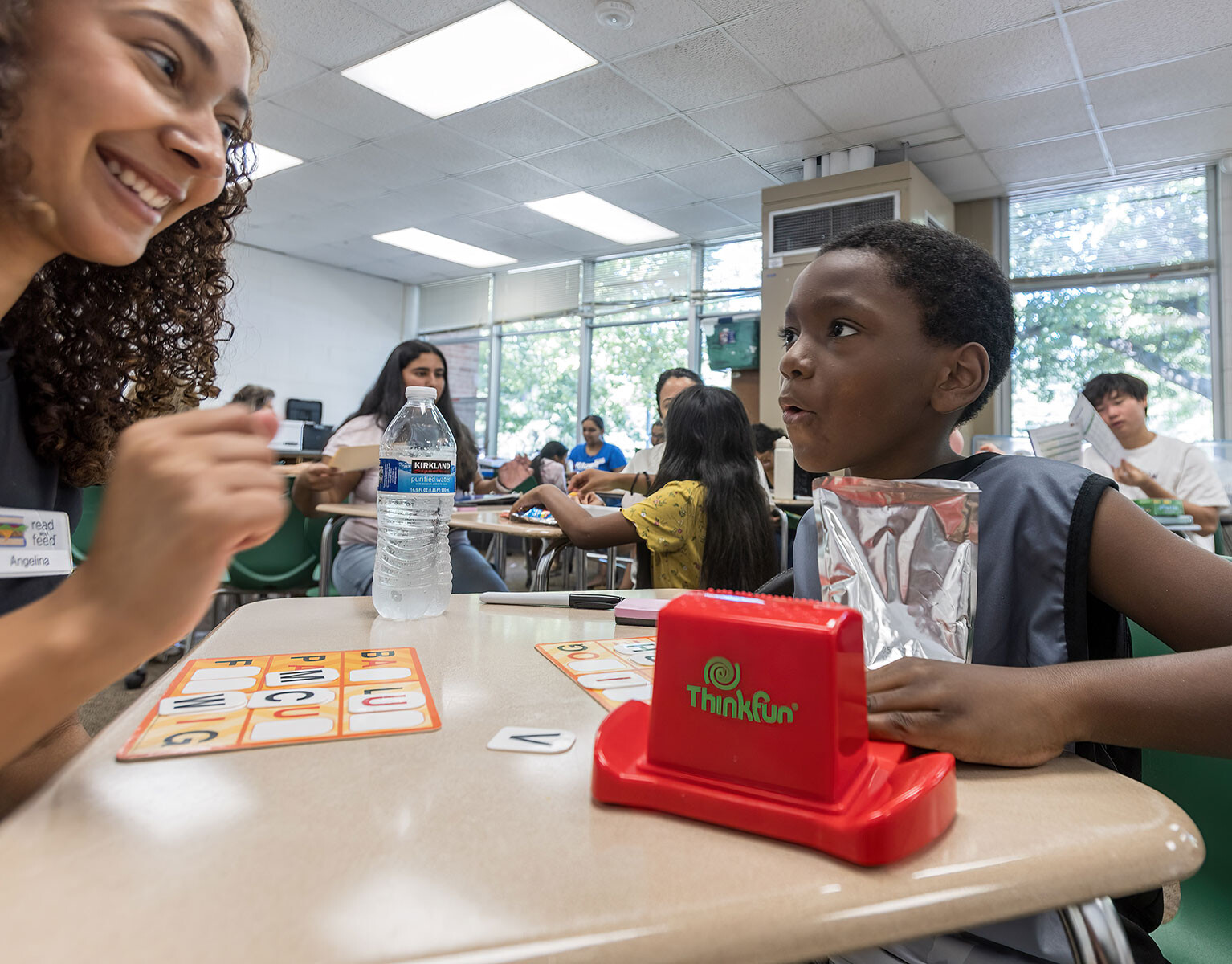
Isaiah Scott, 7, plays word game Zingo with program coordinator Angelina Ross.
Jan’s solution was to buy an RV, outfit it as a mobile classroom and library, and begin taking services directly to high-needs neighborhoods. “She really took such a thoughtful approach to how she wanted to serve,” Sherry says. “Let’s eliminate as many barriers for children and families as we possibly can.”
Jan also fed them.
On the very first day, she served sloppy joes and a salad, with strawberry shortcake for dessert. Sherry shares that some of the children had never seen a fresh strawberry before. They didn’t know what it was. That small, specific, and quietly devastating moment became the founding story of the organization’s food philosophy, and it has never been forgotten. “We’re really just still trying to honor that original model,” Sherry explains.
In 2025, Read and Feed tutored 677 students in kindergarten through fifth grade, a figure that represents 88% growth over the prior year, driven in part by the organization stepping in to fill a gap when another program closed suddenly, training 200 additional volunteers in a matter of weeks to meet the need. That same year, through a partnership with YMCA’s Camp Excel and Power Scholars programs, Read and Feed served 2,070 students during the summer alone, a 34% increase over the prior year. Combined with the year-round academic program, the organization distributed just under 32,000 books last year.
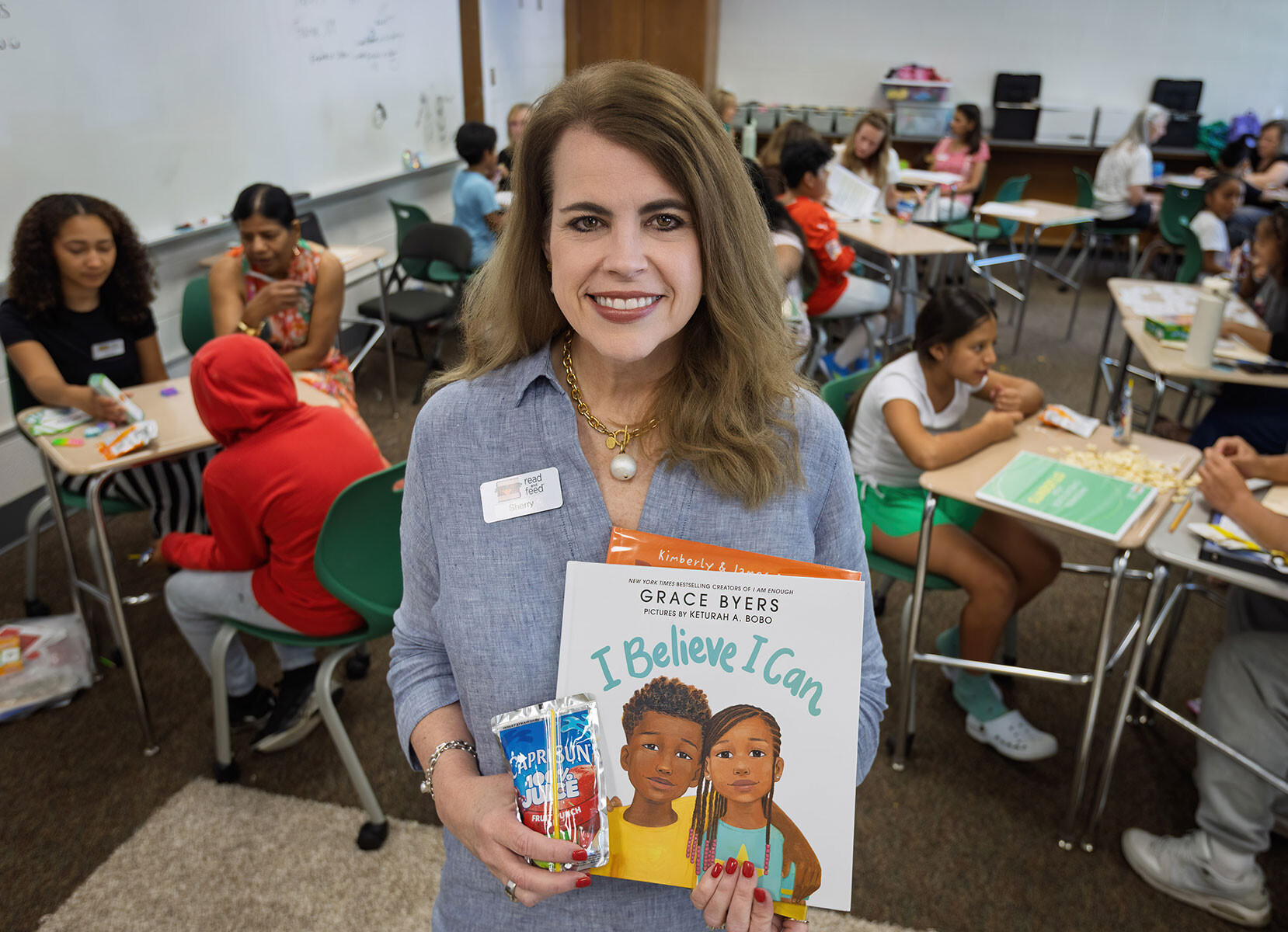
Executive Director Sherry Overton Shudra
These aren’t just statistics. They represent 49 active sites across Wake County — more than double the number since Cary Magazine first featured the organization in 2016 — 614 volunteers, and thousands of one-on-one tutoring sessions in which a trusted adult sits beside a child and works through the five foundational components of literacy: phonemic awareness, phonics, vocabulary, comprehension, and fluency. Each session runs between 75 and 90 minutes, and every session includes food because Read and Feed has always understood that a hungry child cannot learn.
“How can a child focus, whether in our program or in school, if they are worried about their basic needs being met?” Sherry asks. “If they’re worried about whether they have a meal that night at home, it affects every other aspect of their life.”
The meal program, operated in partnership with the Inter-Faith Food Shuttle, looks different at each site. That flexibility is intentional. At some locations, tutors and children sit down together for a full family-style meal, spending 15 or 20 minutes talking about their week and building the kind of trust that makes learning possible. At others, where space is limited or the RV is serving many children, hot meals go home in individual packages that children can heat safely in a microwave (never on a stove). At others still, simple bagged meals with sandwiches or wraps travel home with families.
“We try to be very sensitive” to differing needs, Sherry explains. “We let each location decide what’s best for that neighborhood, or that faith-based location, or even when we’re serving at the school level.”
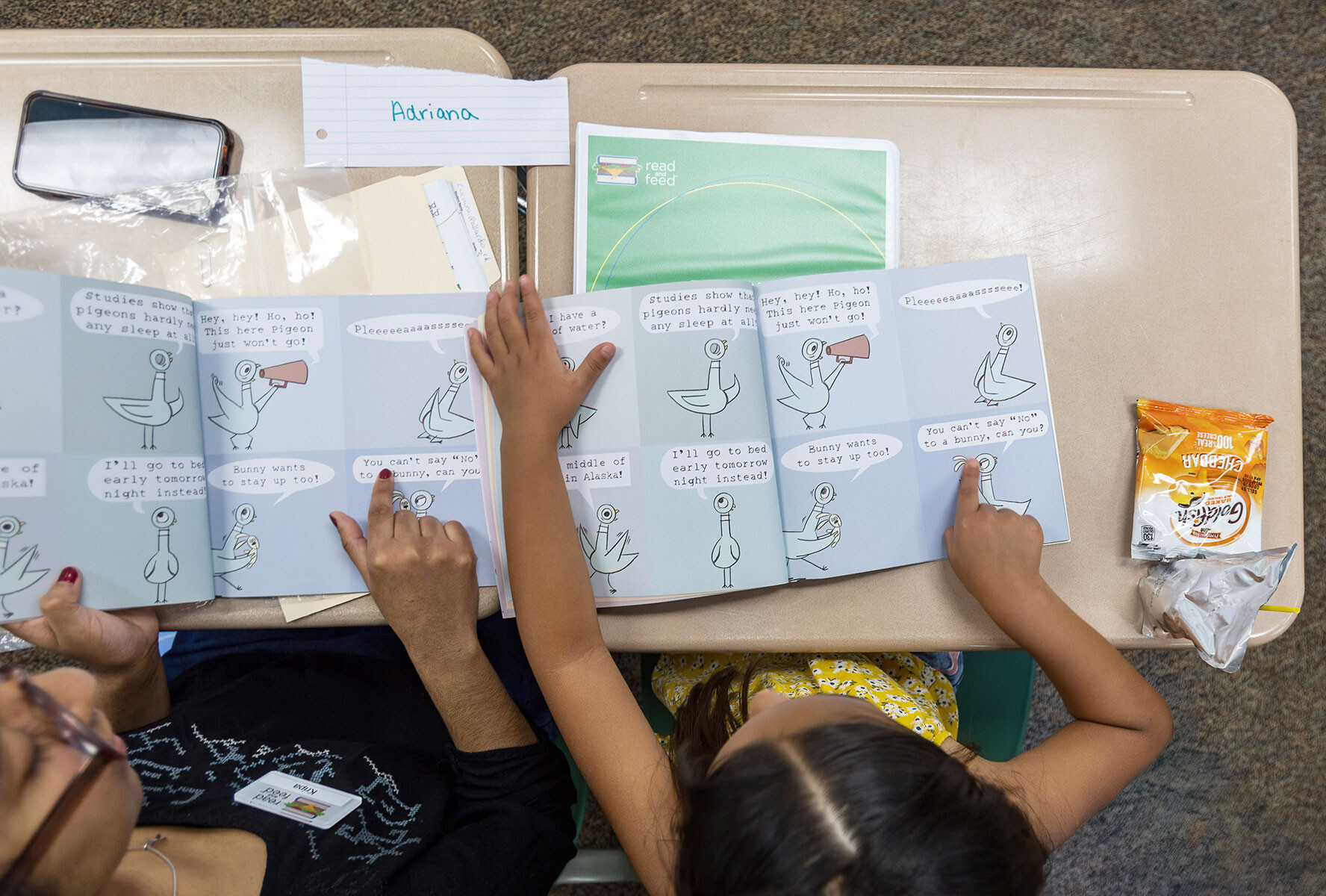
Snack and drink within reach, 5-year-old Adriana Gonzalez practices reading.
The effects of that feeding reach far beyond nutrition. Children who know they’ll have a meal at Read and Feed that afternoon are more likely to show up to the program and to school. Attendance improves. Anxiety decreases.
“Shockingly, or maybe not so shockingly,” Sherry says, “the meals help play a part in that. Very often we’ll see that children may be referred because they have a significant food insecurity issue, and then that’s a day that they don’t have to worry about, and they look forward to it, and they’re excited about coming.”
They may come for the food. But they stay for the books, the tutors, and the confidence that builds slowly, session by session, one new word at a time.
At the end of every Read and Feed week, children choose three books to take home. Forever. Over the course of a full academic year, a child collects anywhere from 80 to 100 books — enough to constitute a real home library.
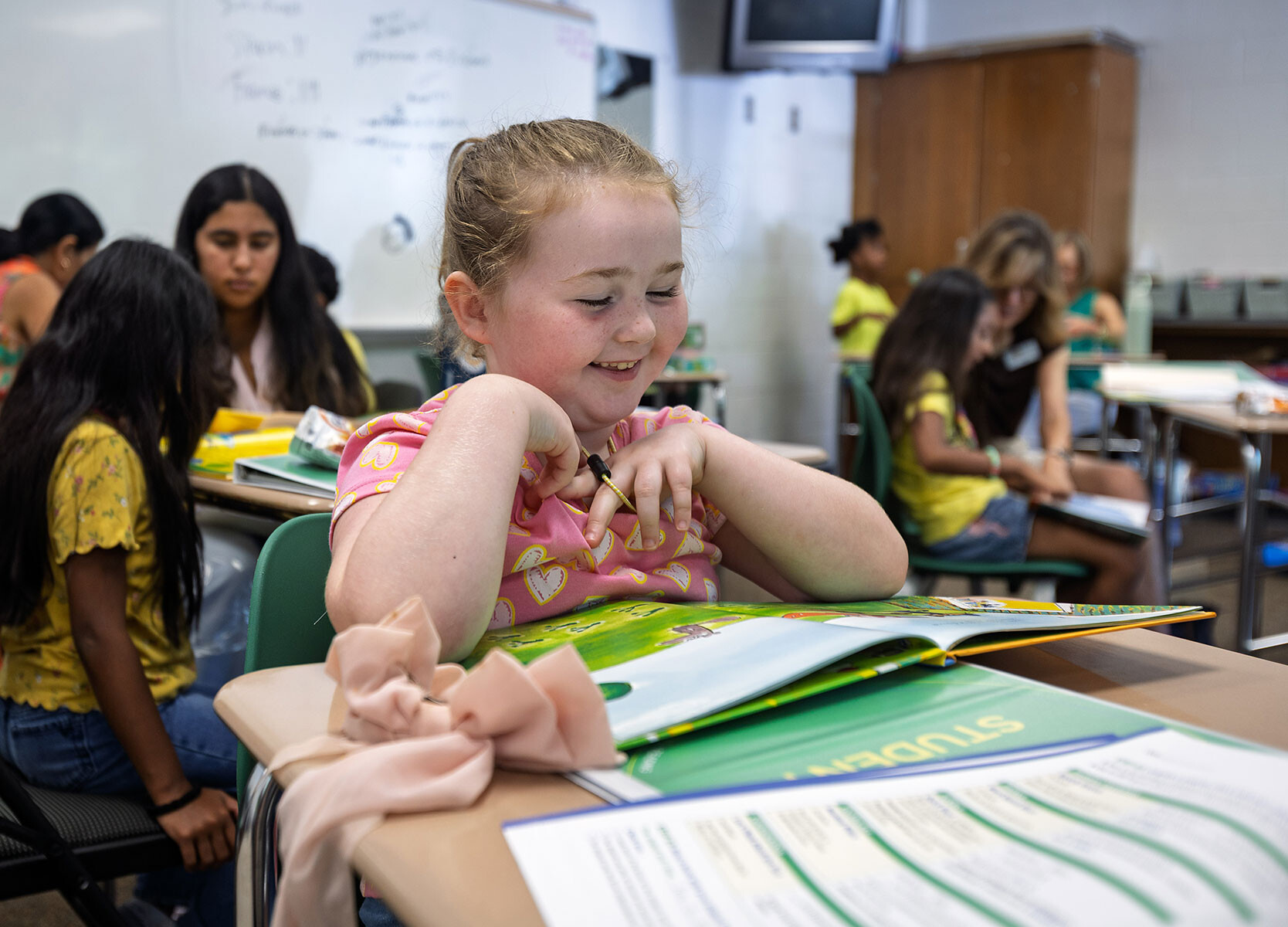
Eight-year-old Allyah Grothe giggles while reading her story.
“There’s something about that ownership,” Sherry explains. The self-selection is deliberate. Children choose what calls to them: sports, picture books with beautiful art, whatever their heart desires. Last year alone, nearly 32,000 books were given away. The community donates between 40,000 and 50,000 books annually, and a team goes out regularly to pick them up.
None of this happens without people. In 2025, Read and Feed had 614 active volunteers — a 37% increase over the prior year — drawn from every corner of the community. Retirees who have the time and the patience. College students logging hours and building experience. Spanish speakers serving a student population that includes a significant percentage of English language learners, so that children are never put in the position of having to translate for themselves.
Each volunteer is background-checked annually, without exception, which is why volunteers must be adults. Each is assigned to a specific child, building a relationship that by design forms the core of the program. “Even just spending that time makes them feel safer,” Sherry says. “It makes them feel very secure, and it makes them trust our program.”
When she needs a reminder of why she stays up until midnight writing grants and asking people for money? She goes to a site. At a book distribution earlier in the summer, she looked down to find a kindergartner with arms wrapped around her legs. “That big hug,” she says, “and thanking me for bringing all the books that day … sometimes you just need that experience to remind you why you do all the things.”
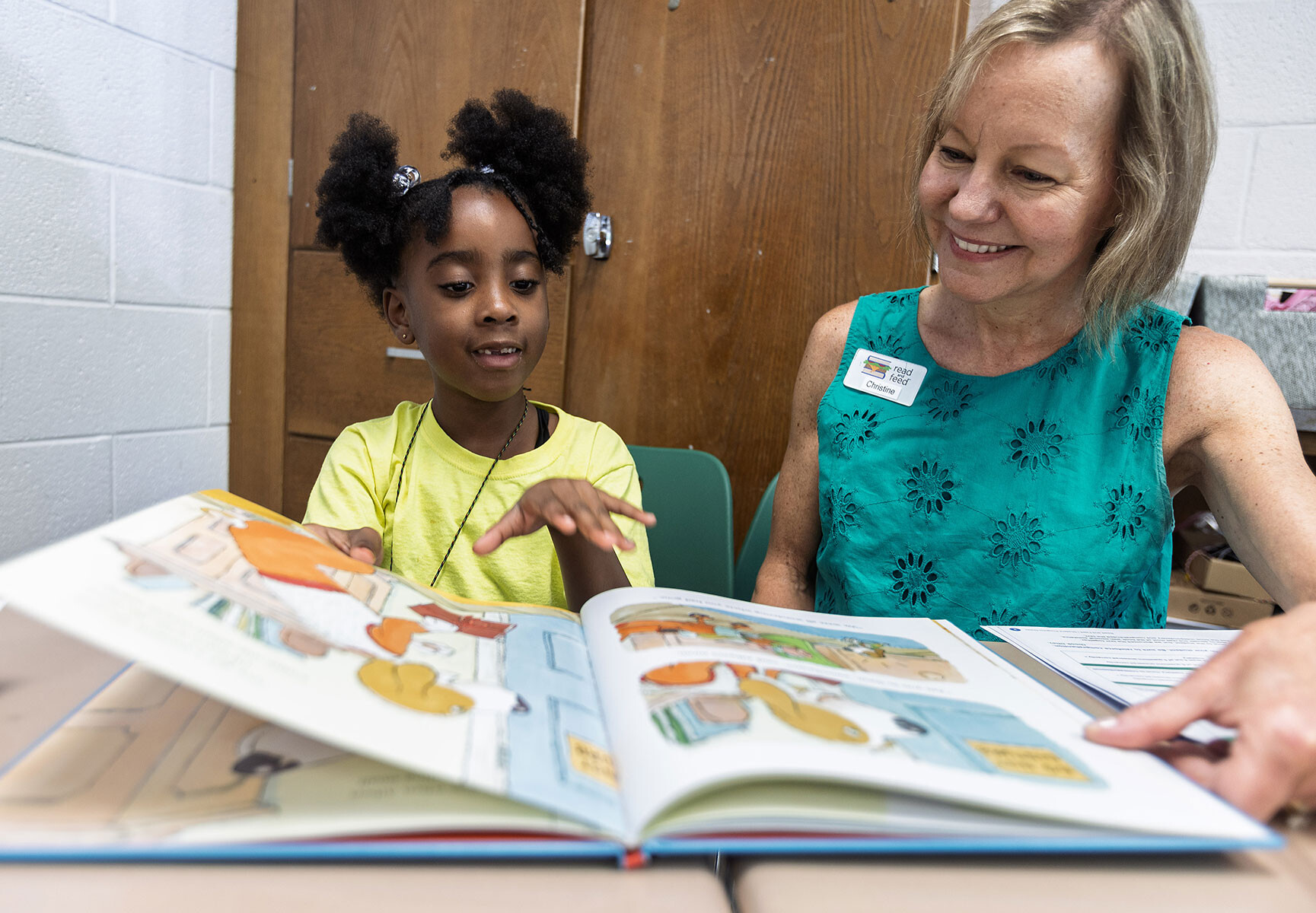
Tutor Christine Johnson and 7-year-old Laylay Patrick share the joys of reading.
Next spring, Read and Feed celebrates its 20th anniversary. It does so with its sights set well beyond Wake County. The organization is already operating in Durham, Orange, and Chatham counties and sees urgent need in Johnston, Harnett, Lee, and every county that touches Wake. As housing costs push underserved families farther outward, the need follows them. “We want to be part of that help in those surrounding areas,” Sherry says. The ambitious goal is a 3 to 10 times growth within three years and is entirely dependent on community support.
That support can take many forms. Financial donations, which remain the most critical need as federal funding tightens and nonprofit partners face difficult reductions. Volunteer hours not only as tutors, but sorting books, picking up meals, welcoming children at the door. New or gently used books through wish lists on Amazon or at local bookstores like Quail Ridge. Snacks. Presence.
“There’s a way for everyone to get involved,” Sherry says. “They just have to decide what best fits their schedule and their budget.”
The question ultimately isn’t whether this work matters. It’s whether we can imagine our community as one in which every child finishes third grade reading proficiently, fed, and confident that someone believes in them. Read and Feed has spent 20 years proving that it is possible.”
readandfeed.org
@readandfeed

- Erica Chats: Special Occasion Spots
- Defined by No Definition: Shijiri Sushi Bar
- Familiar Faces: Patrick Stapleton
- Pay It Forward: Read and Feed
- Small Business Spotlight: Vino & Tap
- Noodle Blvd
- Garden Adventurer: The Riddle of Swiss Chard
- Liquid Assets: Sicilian Sun Martini
- Grounds for Connection: The Turkish Coffee Lady
- All In
- Things to Do: August 2026