


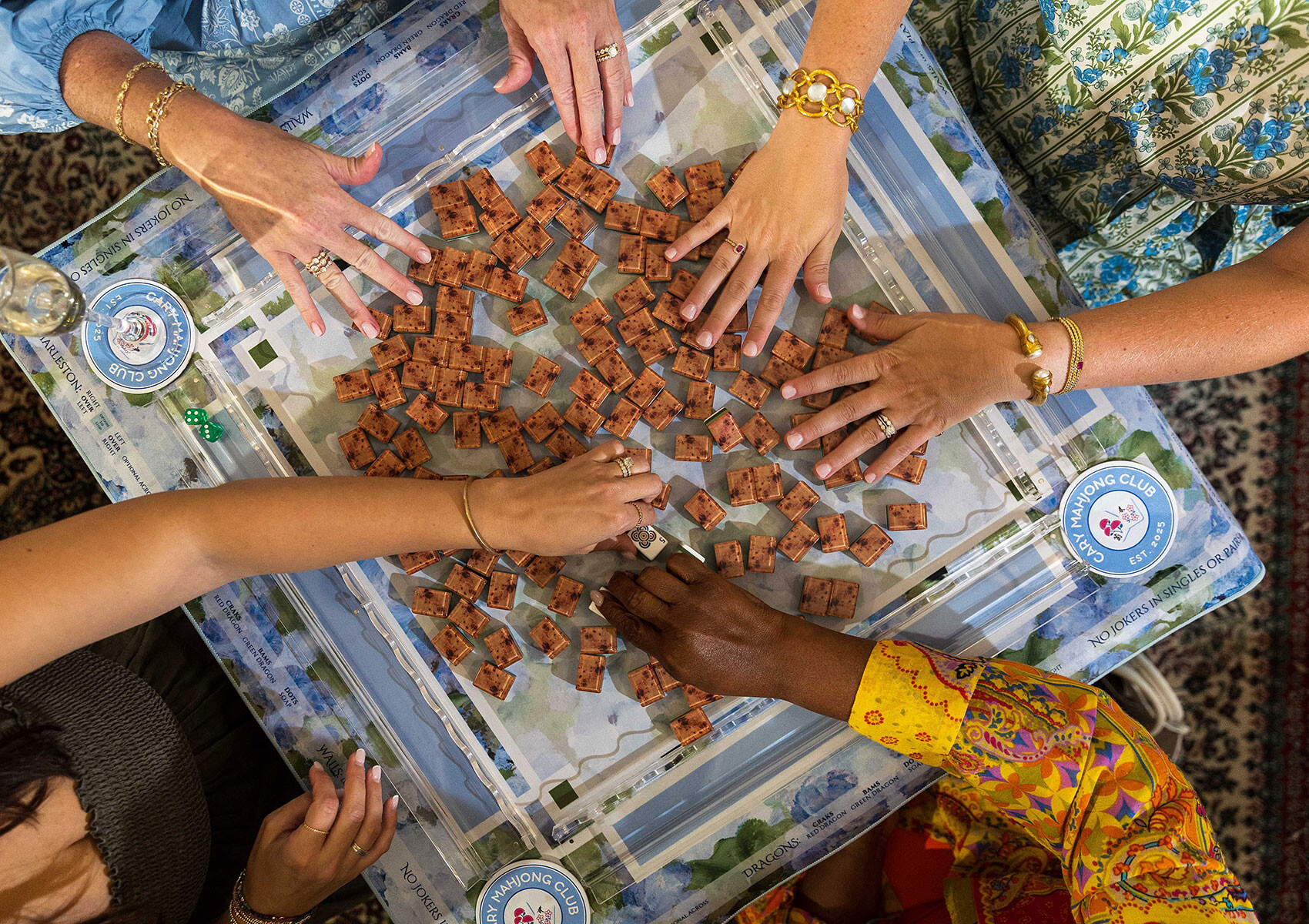
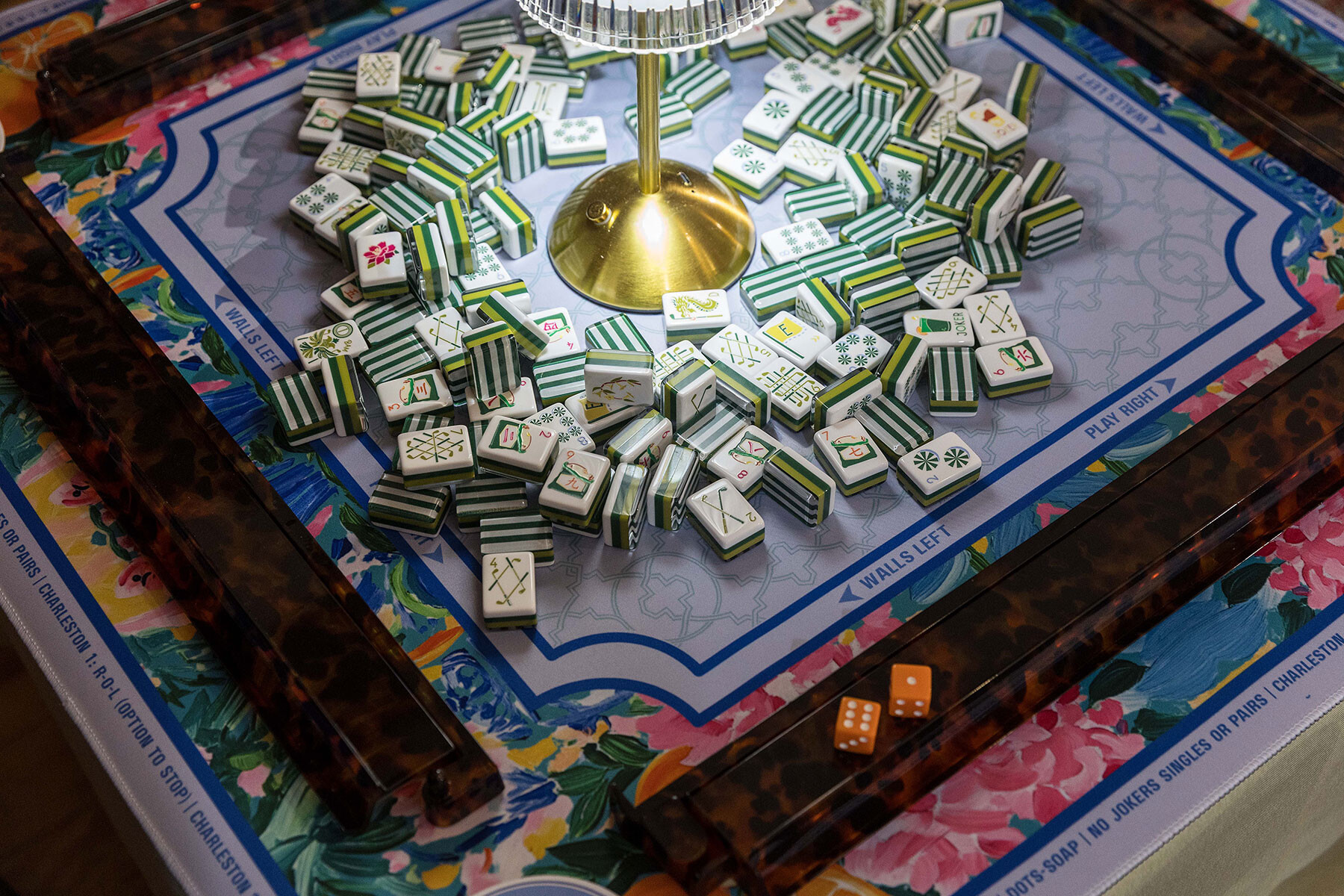
The tablecloths go down first. Then the mats — sound-absorbing, patterned just so, chosen because a hardwood floor and clacking tiles is a genuinely loud problem to solve.
By 6 p.m. on August 4, “the library” room at Hearsay cocktail bar in downtown Cary’s The Matthews House is arranged for precisely one purpose: mah jongg.
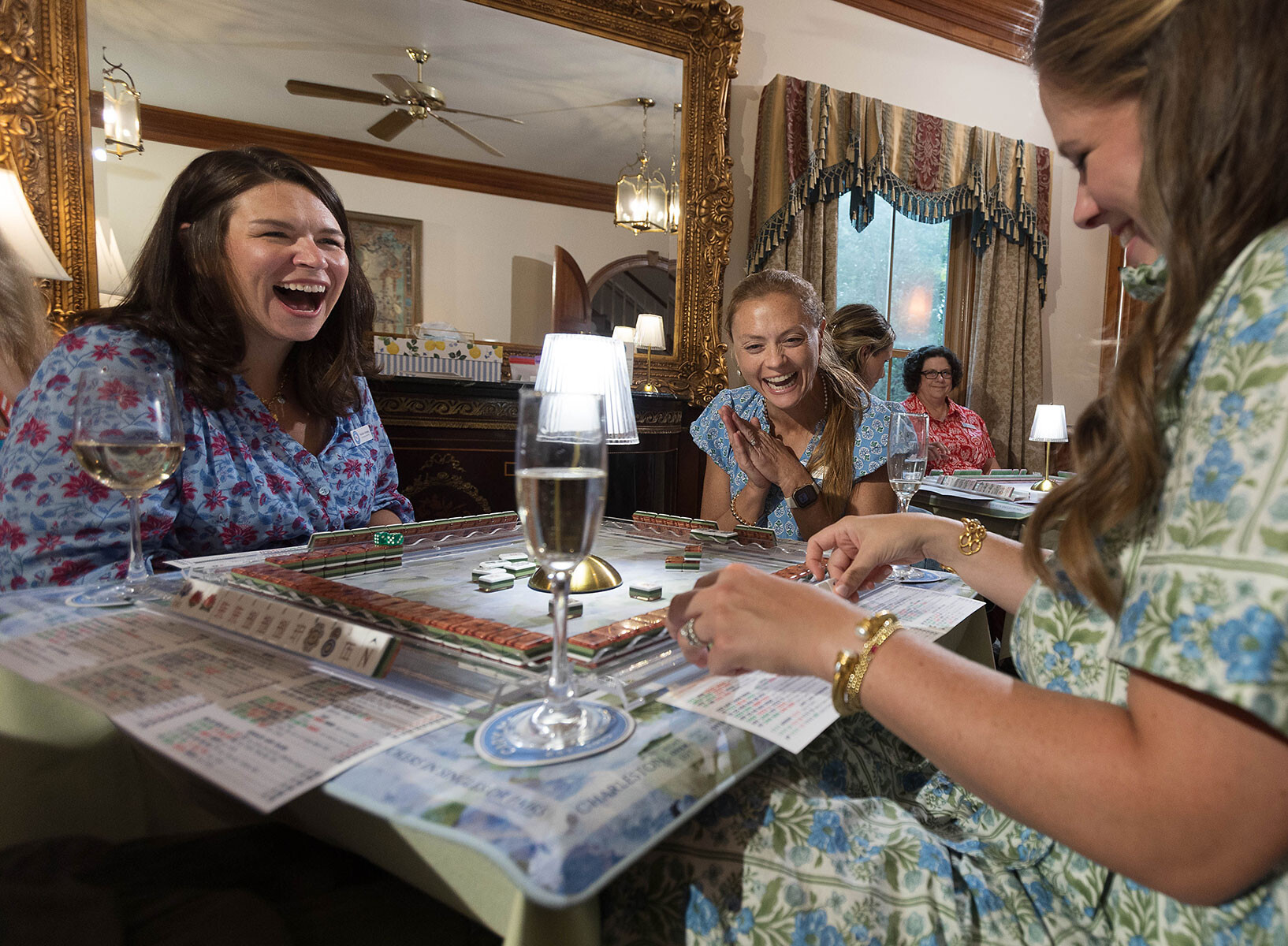
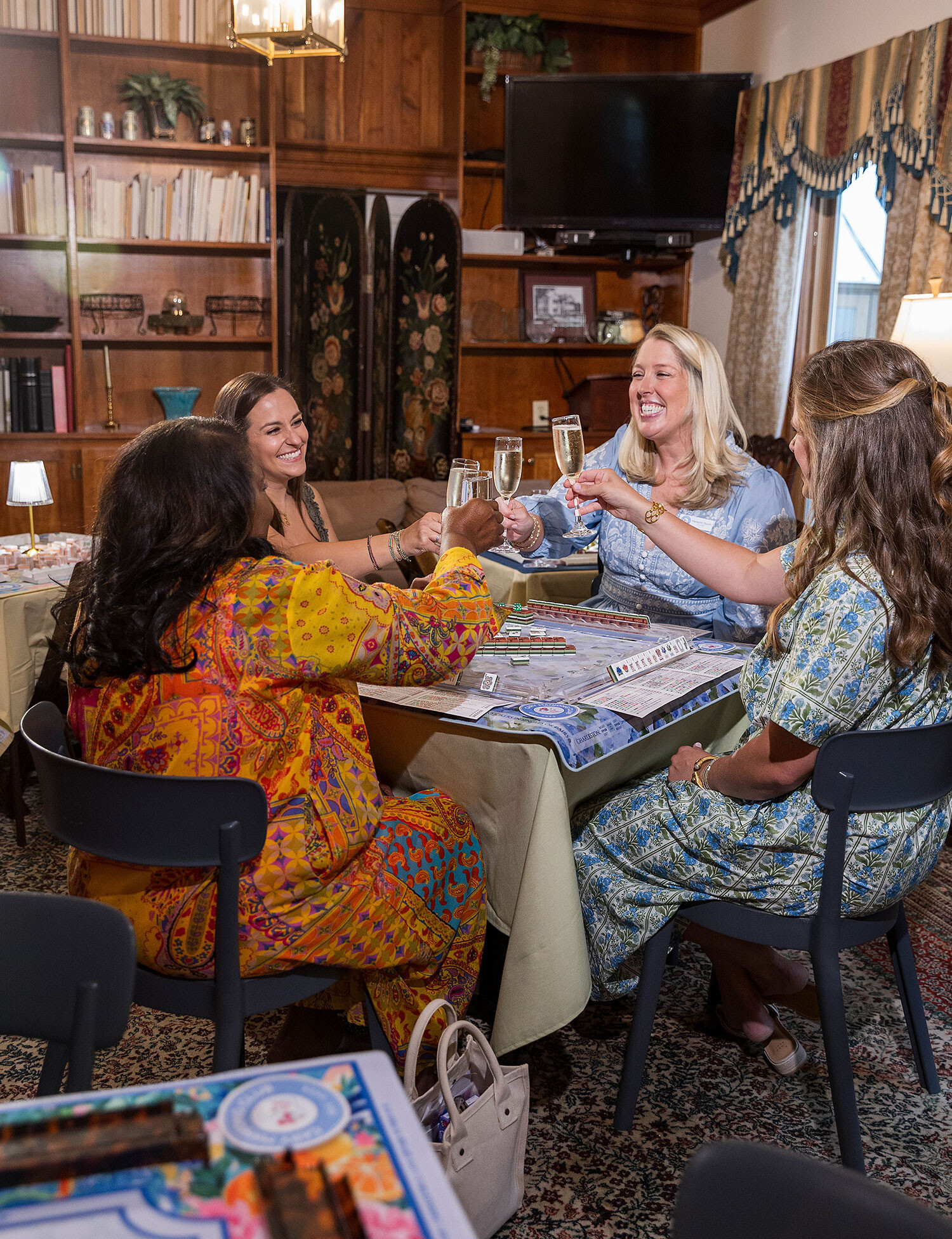
Women trickle in early to pick their favorite tile set, save a seat for a friend, and grab a cocktail before settling in for two hours of open play in which nothing else, not a work email, not a group text, not a family member, is allowed to distract them from the game at hand.
This is Cary Mahjong Club, and one year ago the group didn’t exist.
What started as two moms driving 45 minutes each way for mah jongg lessons has become a club with a wait list that regularly tops 40 people, events that fill up to 10 tables at a time, and a growth rate that has caught even its own founders off guard.
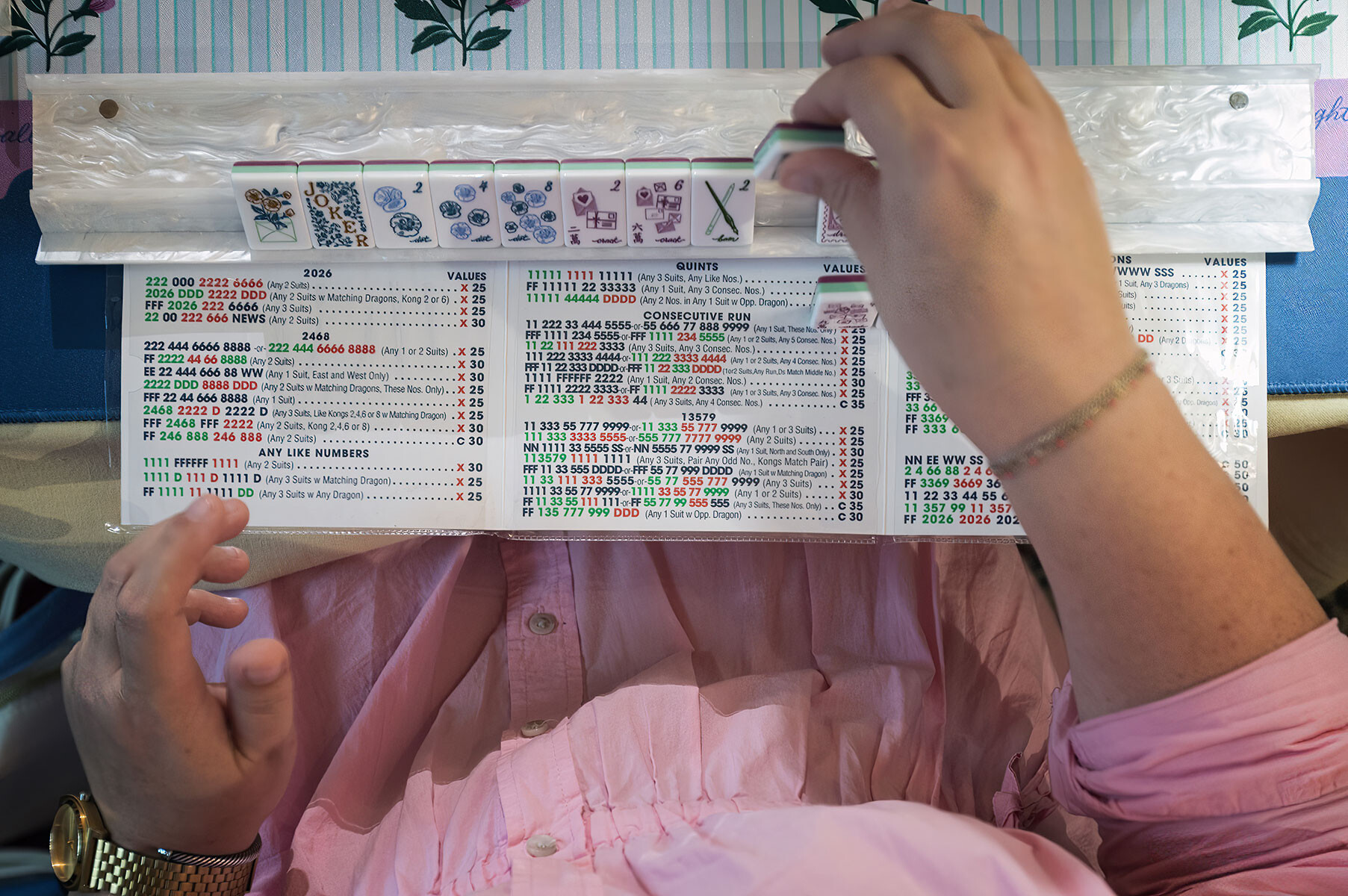
The scorecard resets each year on April 1, placing new and experienced players on equal footing.
It’s also a snapshot of a national mah jongg boom that has seen bridge clubs bleeding members, a $350 designer-tile-set economy springing up around it, and droves of women trading screen time for tile time.
35,000+: people Dana Lange estimates she’s personally taught to play mah jongg
97%: how often a player who abandons the Charleston early ends up losing, per Dana’s data
$59–$350+: price range from a basic starter set to a designer tile set
40+: the typical headcount on Cary Mahjong Club’s wait list
September 23, 2025: the date Cary Mahj hosted its first open play
April 1: the date the official scoring card annually resets nationwide
Two Moms, One Drive Too Many
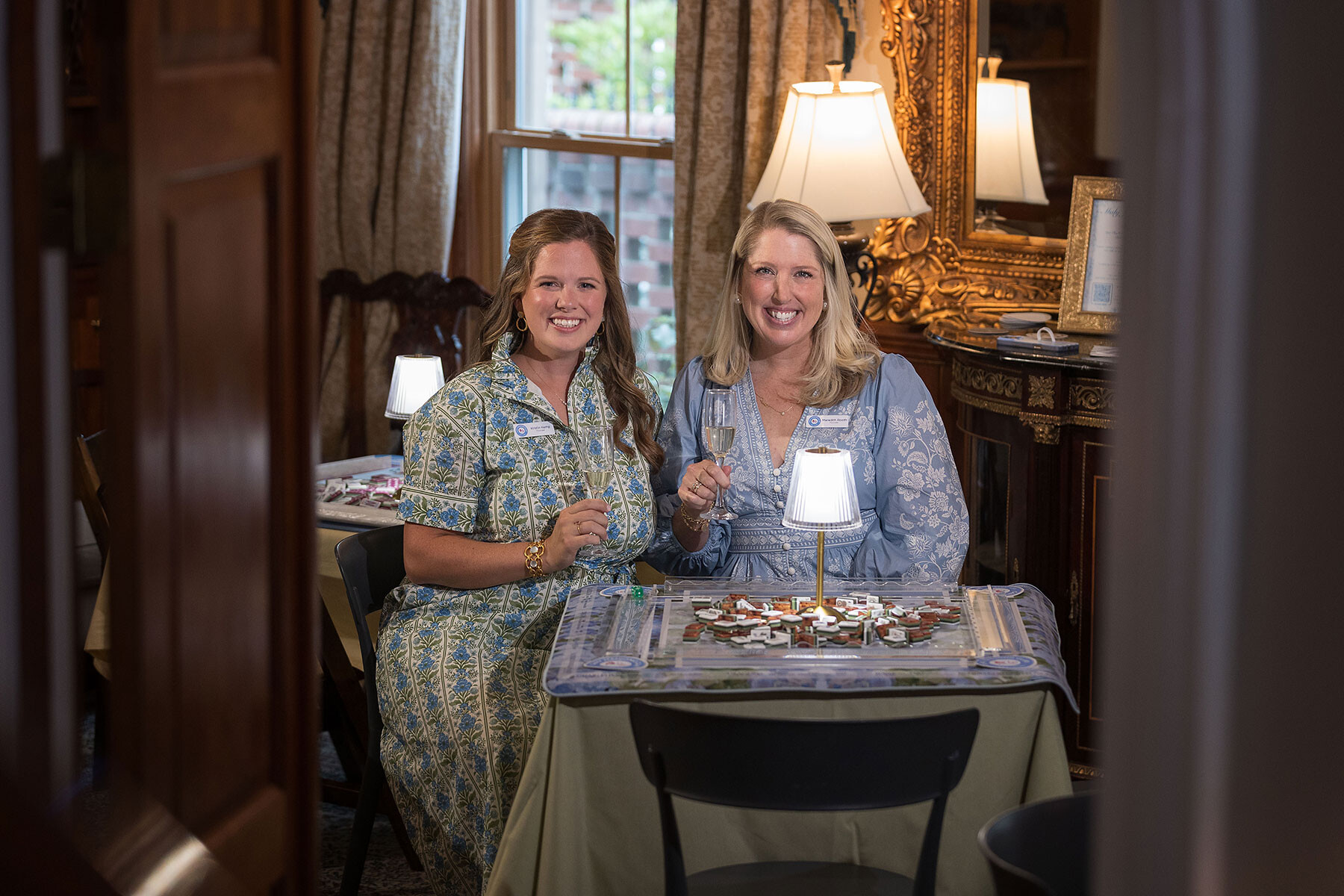
Meredith Rooth and Kristin Kemp met the way a lot of Cary friendships start: at their kids’ school. Both career women had recently become stay-at-home moms and were still navigating the associated identity shift.
Both had also separately begun noticing the same thing online: women gathering to play a game with strikingly pretty tiles.
Within 24 hours of the first mention of learning mah jongg, Meredith and Kristin had booked lessons and found their way to Monthly Mahj, a Fuquay-Varina group that hosts informal get-togethers and teaches beginners the basics.
But Fuquay-Varina also meant long commutes for the Cary women, making childcare logistics even more complicated.
“Cary doesn’t have its own group,” Meredith remembers thinking, “which is kind of crazy.”
So she and Kristin started one, with Cary Mahjong Club playing its first game on September 23, 2025, at Hearsay.
It’s grown every month since, with open and guided play sessions for newer players who still want a coach hovering nearby, and periodic events at Home for Entertaining or South Line Brewing and Bond Brothers Beer Co. that have swelled to 40 people at once.
Membership, which Meredith and Kristin are forced to cap, reopens twice a year. When their own wait list runs too long, they refer people to sister clubs like Apex Mahjong Club, which was founded by women who learned to play at Cary Mahj.
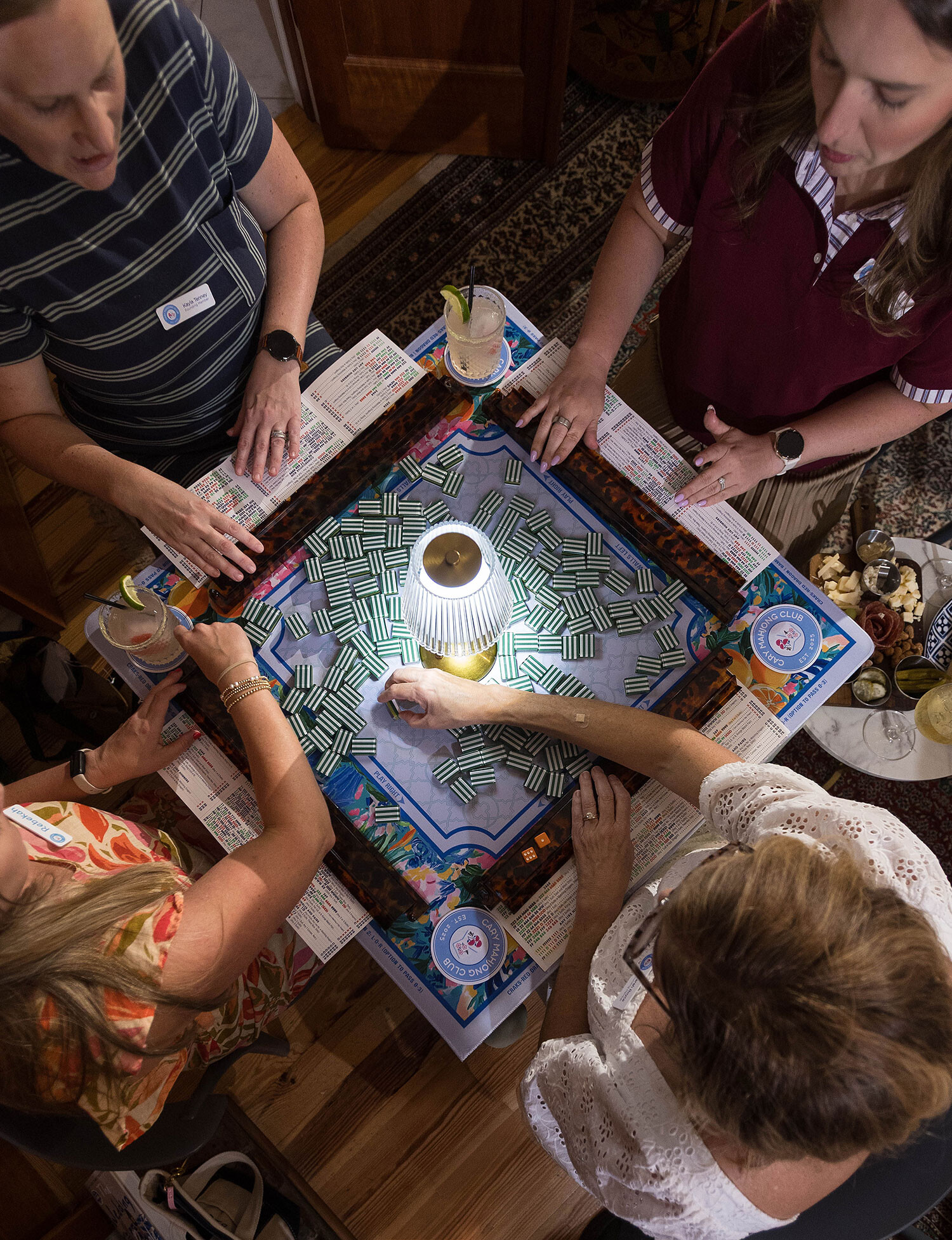
Cary Mahjong Club players build the wall before a game, scorecards and cocktails in easy reach.
One Table at a Time
Cary Mahjong Club isn’t a local anomaly. Since 2018’s Crazy Rich Asians, which gave American audiences a 30-second glimpse of the game in a scene loaded with strategy and symbolism, mah jongg’s popularity has been steadily climbing.
The current surge, however, traces more directly to the pandemic. After being confined to their homes, people wanted a reason to sit across a table from another human being.
Instructor Dana Lange is only half-joking when she credits the country’s political exhaustion with part of the boom. People wanted some time and a space where the only thing anyone had to agree on was whose turn it was.
It’s worth clarifying up front that the version fueling the boom is specifically American mah jongg, which is a distinct offshoot of the ancient Chinese game. It was standardized by the National Mah Jongg League in 1937.
The two versions share a wall of roughly 144 to 152 tiles and the basic mechanics of drawing and discarding, but they diverge from there. American play adds jokers, a scoring system, and a printed card that is reissued every year and lays out some 1,400 possible winning hands (none of which exist in the Chinese version).
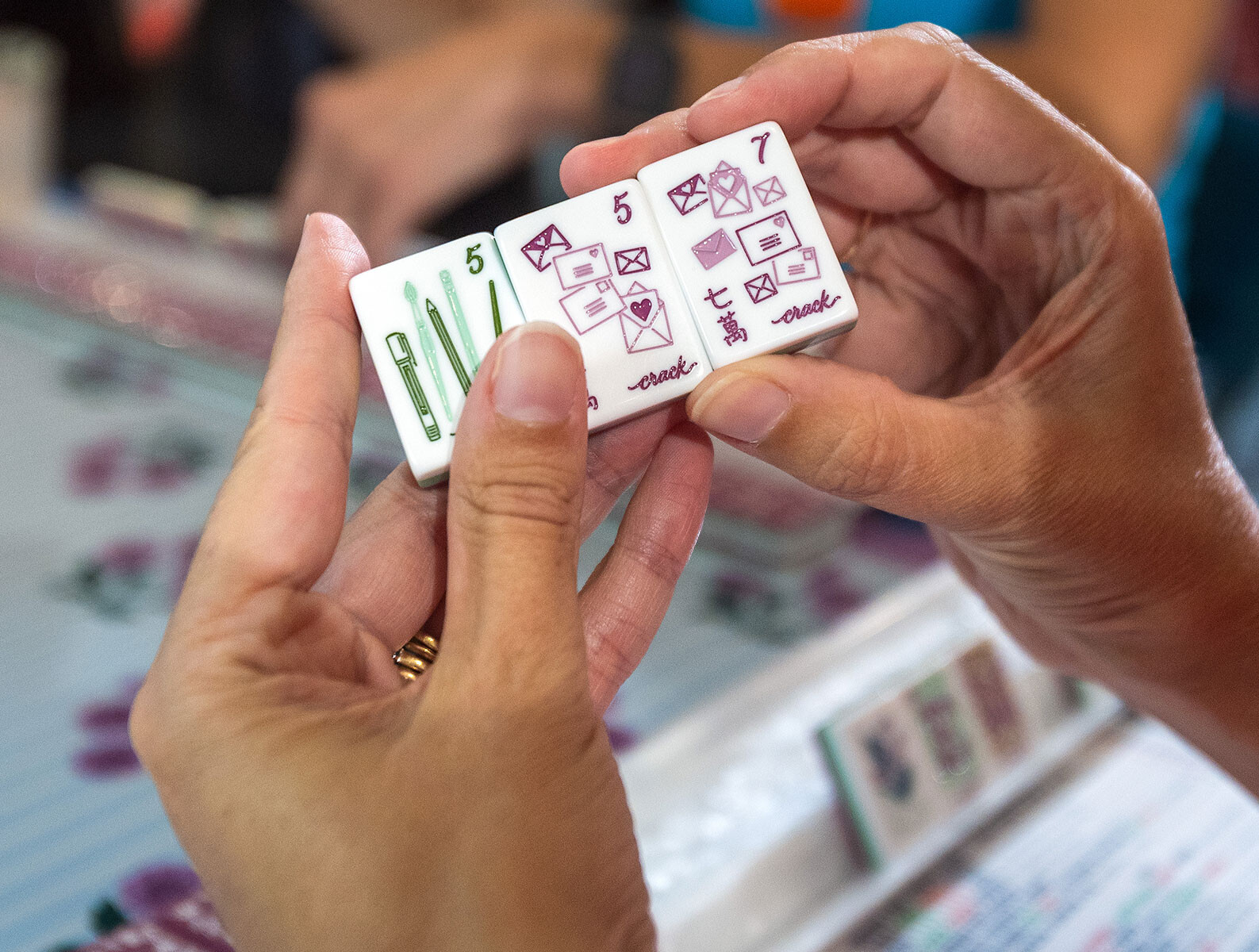
The commercial side of the American mah jongg boom is hard to miss. A basic starter set runs about $59, whereas designer tile sets in acrylic, marble, or hand-painted porcelain sell for $350 and up.
Marketed by a wave of manufacturers who’ve caught on to the photogenic nature of the game, several of those same companies have started certifying “teachers” after little more than a single day of play. (Dana is passionate about beginners vetting a teacher’s experience before signing up for a two-hour crash course that, in her words, sets them up to fail. Her own beginner class runs nine hours across several days.)
The Charleston: The mandatory rounds of tile-trading that open every hand; players pass three tiles at a time before play begins.
The Wall: The stack of face-down tiles players draw from during the game.
Calling a tile: Claiming a tile another player has just discarded, if it completes a valid three-(or more)-of-a-kind grouping.
Exposure: A completed grouping made by calling a tile, laid face-up on the rack for the table to see.
Mah Jongg!: The winning call, made once a player holds all 14 tiles needed to match a pattern on the year’s official card.
Little sparrow: The literal translation of “mah jongg,” a nod to the sound of shuffling tiles once said to resemble birds chirping.
Learning to Think, Not What to Think
Ask almost anyone in Hearsay’s library room who taught them, and it is Dana’s name that comes up.
Dana has been playing mah jongg since childhood. Her grandmother, a fiercely competitive Chinese mah jongg player in Knoxville, taught her the game and, notably, never let her win.
But it was American mah jongg, learned decades later from a neighbor in Durham, that stuck. After years of slow, painful lessons squeezed between international work trips — “I had a headache for a year,” Dana admits — she finally mastered the game the old-fashioned way: by playing constantly.
When a Durham Academy fundraiser asked her to teach a class, it sold out in 10 minutes and had a waiting list of 40. Dana has now taught approximately 35,000 people how to play.
Much of her teaching happens at Home for Entertaining, which has played a prominent local role in mahj taking off. “We did not set out to be a hub for mahj,” says Jackie Serany, the store’s director of retail. “We started selling some product, invited Dana in for lessons, and it organically grew from there.”
Jackie credits Dana with bringing more than expertise through the door. “Dana has brought mah jongg knowledge to Home for Entertaining, but more importantly friendship, laughs, and community,” she says. “People are coming to learn the game and are leaving with so much more.”
Dana’s reach extends well past North Carolina. In addition to being flown around the world to teach groups of all kinds, Dana runs private one-on-one lessons over Zoom for students as far away as Switzerland, Spain, England, and Canada.
When asked what separates a good mah jongg teacher from a good mah jongg player, Dana says it is understanding that people learn differently and refusing to just hand them the answer.
“I never pick your tiles for you,” she says. “You have to pick them. Show me what you’re thinking and let me hear why.”
Beginners learn the rules. Everyone beyond that is learning to weigh trade-offs, a skill Dana has studied closely enough to pull player data from to prove her point.
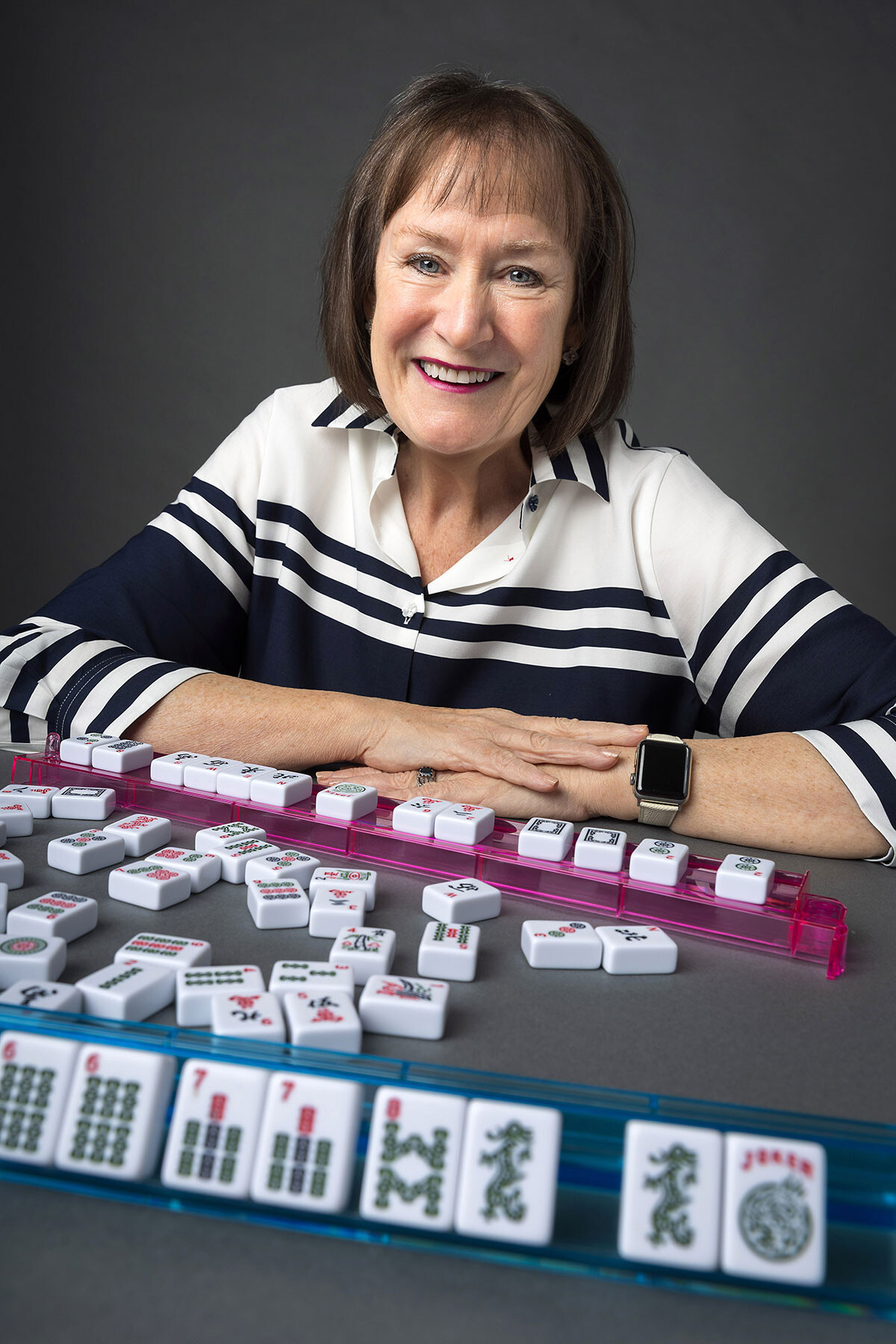
Expert instructor Dana Lange
One finding is that players who abandon the Charleston (the mandatory early rounds of tile-trading that open every game) lose 97% of the time, almost always because they quit out of indecision and not strategy.
Complicating — or complementing — matters is that the winning patterns reset every April 1, when a new scorecard is published and the entire community of beginners and experts alike starts over on equal footing.
Dana studies the new card obsessively each year before she teaches it, calling the process “being a puppy again,” forcing her to imprint new favorites annually instead of coasting on muscle memory.
Bio-neuroscientists, she notes, love this about the game because it keeps aging brains building new pathways instead of relying on old ones.
Dana’s real contention, though, is one that Cary Mahj’s founders have also clearly absorbed: What someone else discards matters more than what you were dealt.
“In mah jongg, at some point,” Dana tells her students, “you have to get rid of everything you can’t use in order to win.”
What ties Home for Entertaining, Dana, and Cary Mahj together? From Jackie’s viewpoint it’s a shared belief that has let all three grow at once: community over competition.
A Room Intended to Welcome
Talk to the women at a Cary Mahj table long enough and a favorable comparison of mah jongg to bridge emerges. Meredith confirms that Cary Mahj was built, deliberately, to feel the opposite of gatekept. Open play means sitting wherever you want, with whoever’s free, at whatever skill level shows up.
Nobody corrects, nobody hovers, and etiquette taught to them by Dana — congratulate the winner, don’t narrate your near-miss, no whining — keeps competitive players and total beginners at the same table without friction.
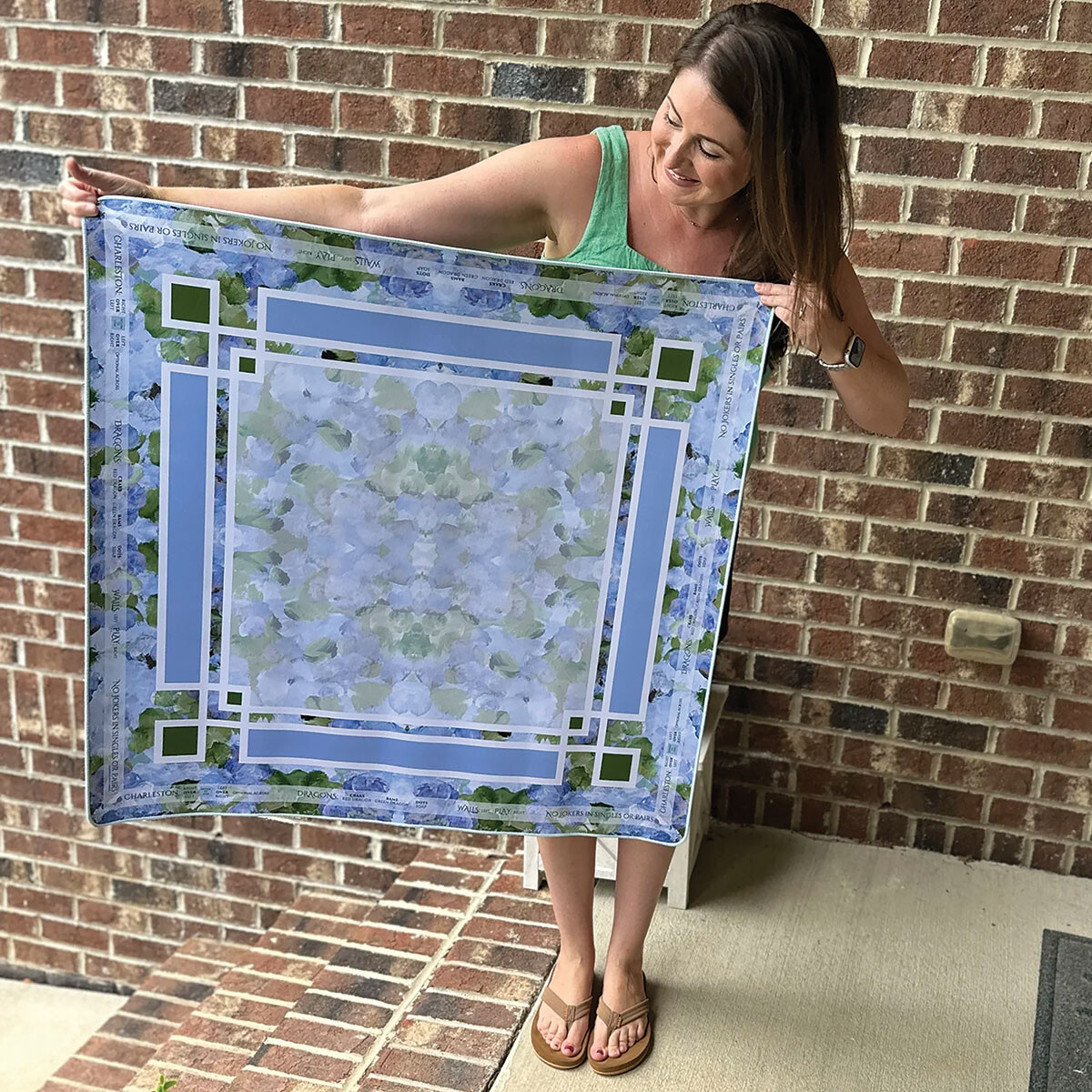
A classroom teacher for seven years, Amanda Toppe picked up a paintbrush for the first time during the pandemic, painting small canvases as a creative outlet. When strangers started asking to buy them, what she calls a nightly ritual grew into Amanda Toppe Living, her Apex-based studio that turns original paintings into mah jongg mats and accessories.
Amanda recently learned her great-grandmothers played mah jongg, joining grandmothers and a mother who still do — and her husband’s family has its own lineage of players. The couple now plays on tiles inherited from both sets of grandmothers. “It made mah jongg feel less like just a game and more like a heritage,” she says. “It’s a really neat connection between our two families.”
Amanda’s design rule is the art should frame the game, not compete with it. Color and detail live along the mat’s edges, while a calm, neutral center keeps the tiles easy to read. Her mats found their way into Home for Entertaining after Cary Mahj co-founder Meredith spotted one in use at a club night and introduced Amanda to the store’s Jackie Serany on the spot.
amandatoppeart.com
@amandatoppeliving
For some, the stakes go beyond a pleasant night out. Dana says she regularly hears from students who have lost a spouse and found themselves, for the first time in years, without a built-in reason to leave the house — until mah jongg gave them one.
“People become friends with people they would have never known before,” she says, calling it an ecumenical game: Rich or poor, retired or still working, none of it matters once everyone’s at the same table.
Cary Mahj bears out the same effect on a smaller scale. Its roster mixes stay-at-home moms, working professionals, retirees, and grandmothers — women with little reason to have been naturally introduced to each other, outside of a shared night and a rack of tiles.
For some, the pull is purely about carving out a version of themselves that motherhood doesn’t touch. Kristin, who considers herself competitive, describes playing as switching on “a different part of your brain.”
Meredith watched her mother run a monthly bunco group for decades and had wanted that same standing appointment with friends ever since. Cary Mahj became it.
For second-generation player Megan Cohen, who was new to the area, the tile game her mother played became how she found her new community.
The warm Cary Mahj welcome extends across generations, too. One of the club’s more seasoned players, Jay Laney, took up the game three years ago because her daughter, living in Alabama, insisted she learn. (That same daughter went so far as to reach out to Cary Mahj on her mother’s behalf, applying some loving pressure to keep her playing.)
In fact, Jay’s grandsons — ages 22, 20, and 12 — all play now, and Dana says that younger minds pick up the pattern recognition effortlessly.
Some toddlers of the players at the table have picked up the game’s name before they can spell it. Kristin recalls her 2-year-old spotting a tile set in a shop window and announcing “Mah jongg! Mah jongg!” to a startled store owner.
While a simplified children’s version played with seven tiles instead of 13 or 14 exists, one of the draws of Mah Jongg is its intergenerational appeal.
The possibilities for the game are many, with Meredith mentioning her recent foray into a floating version played in the pool using 3D-printed hollow tiles.
The demographics are also starting to shift. After decades as a game associated mostly with women, Dana says men have begun showing up to her classes in real numbers. This has also played out at Cary Mahj’s tables, where male partners increasingly angle for a seat.
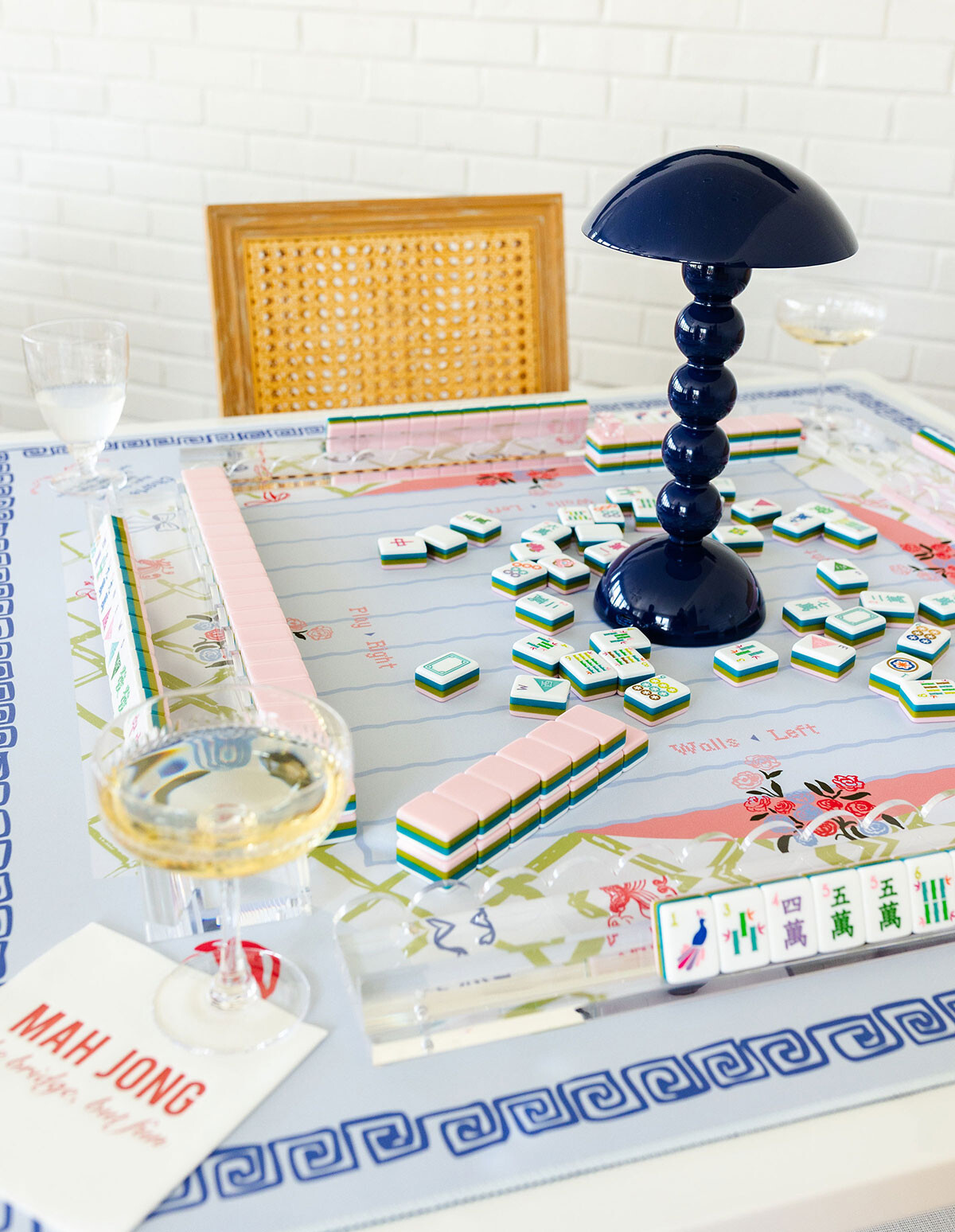
Downtown Cary’s Home for Entertaining has become a community hub for players, offering mah jongg retail, events, and classes. Photo by Jacqueline Reid Photography
Home for Entertaining: The game store and event space doubles as a mah jongg retailer. homeforentertaining.com
Gather Goods Co: The gift shop sells mah jongg essentials and accessories and hosts open (and guided) play. shop.gathergoodsco.com
Cary Mahj hosts both open play and guided play for newer players who want hands-on coaching. Membership reopens twice a year. Up-to-date information is available at @carymahjongclub.
Dana Lange teaches beginner and beyond-beginner classes at Home for Entertaining, plus private lessons by appointment. Find upcoming sessions
at learnmahjongg.com.
What They’re Passing Along
Cary Mahj hasn’t tried to become a business, and Meredith and Kristin say they intend to keep it that way. There are no franchise ambitions — just a room, a wait list, and a group of players who want to gather.
Even a new baby doesn’t slow things down for long. Kristin spent most of this year pregnant and is only now easing back into regular play. (True to her competitive nature, though, she wins the first game of the night at Hearsay.)
What she and Meredith have built is closer to a pipeline than a company. For every member who can’t get off the wait list, there’s a sister club nearby ready to take them, many started by women taught in the first place by Cary Mahj or Dana at Home for Entertaining.
The store now partners with women-owned small businesses and local artists to curate what Jackie calls a one-of-a-kind mah jongg selection and has opened its space not just for Cary Mahj’s monthly social nights but for mah jongg fundraisers benefiting the local community.
Cary Mahj also uses its growing numbers to support charitable causes. Two ongoing community projects are a school-supply drive for Wake County Public Schools and a fundraiser, named Tiles for Tomorrow, to help build a playground at a local elementary school.
Ask Meredith and Kristin why any of this took off the way it did, and the answer isn’t really about the tiles.
It’s about two hours where nobody’s phone matters, where a stranger becomes a regular becomes a friend — and where, much like the Charleston itself, what gets passed from one woman to the next turns out to matter more than what anyone started with.

- Women of Western Wake: Susan Weis
- Women of Western Wake: Dr. Mariah Walker
- Women of Western Wake: Dr. Bobbi Stanley
- Women of Western Wake: Joanna Helms
- 2026 Women of Western Wake
- Women of Western Wake: Mandy Becker
- Garden Adventurer: The Indigenous Asters of Autumn
- Recipes from Readers: Prosciutto & Peach Pizza
- Liquid Assets: Mi Oaxaca Top Shelf Margarita
- Erica Chats: Small Steps for Self-Improvement
- Familiar Faces: Debbi Burns
- Pay It Forward: Avendelle at Picardy Point
- Meche’s Moment
- Small Business Spotlight: Juliet Books & Beautiful Things
- Betting on Herself: Molly Grantham
- Pass It On
- Things to Do: September 2026