


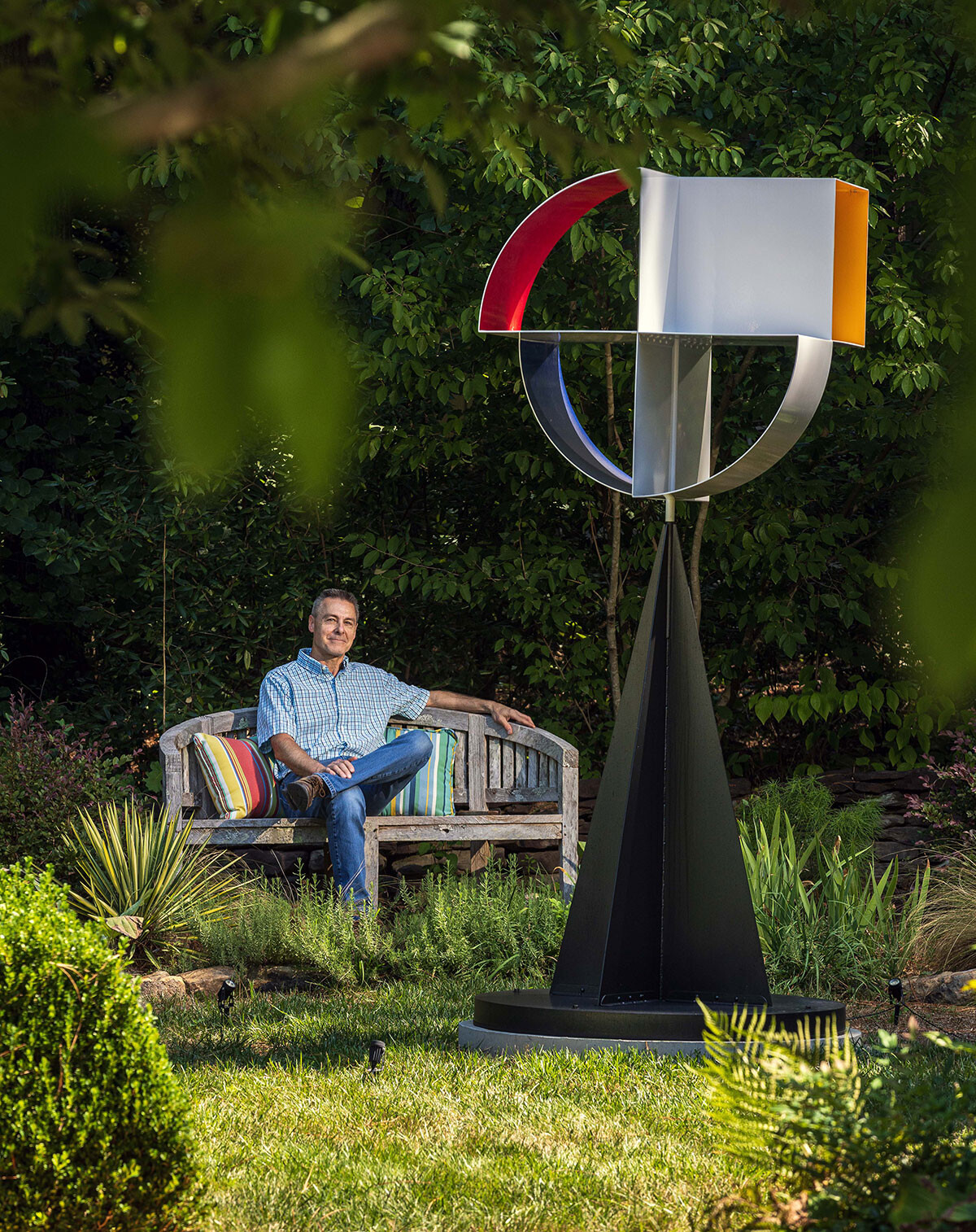
Jeff Dale’s kinetic wind sculpture, Arbor, turns in his Cary garden on ball bearings with the lightest breeze.
There’s a chair in Jeff Dale’s gallery that was sketched out in the backseat of a car. It was 1980, early in Jeff’s relationship with his wife, and their destination was a family reunion. At the time, they were living in Washington, DC, and Jeff was enamored with Southwestern art. It was in the DC apartment that he would fabricate and paint the chair that would be boxed up and forgotten until years later when he’d find it and realize, “Oh, that’s still cool.”
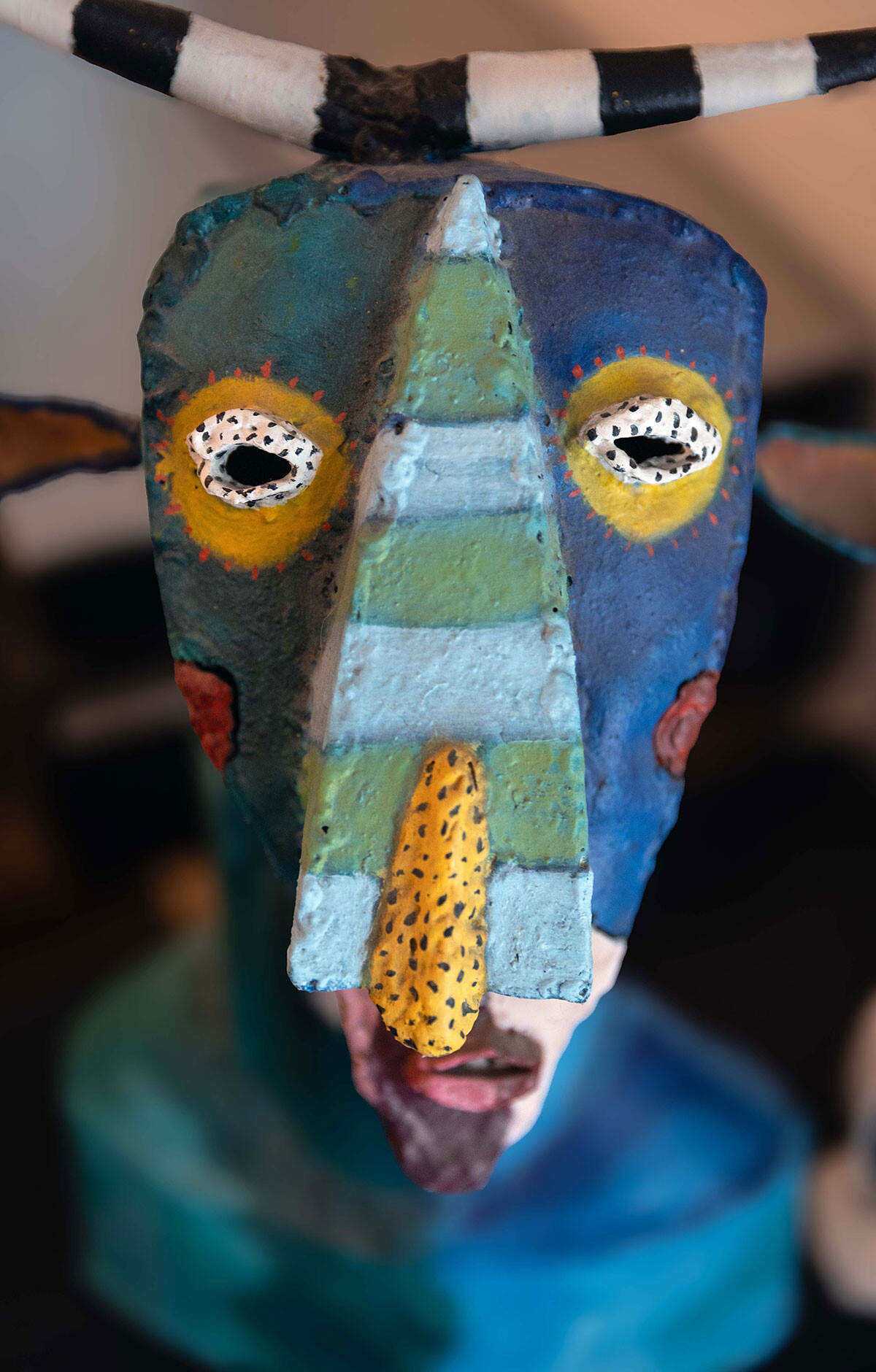
Jeff’s background is in fine art and, for three decades, as a graphic designer.
Downstairs, in his metal studio, sparks are already flying off another project. It’s a custom-designed garden gate featuring an exquisite combination of green and blue stained glass and a handle engineered for one-handed use and shaped to echo the gate’s architectural lines.
Both are Jeff Dale. Neither is the whole story.
For more than 30 years, Jeff has run Dale Design, building brands, logos, and print collateral for a long roster of clients. For the last eight, he’s been building something else alongside it.
Jeff Dale Art forms a body of sculpture and functional furniture in wood, metal, and concrete that has landed him three gallery shows, a Best in Show ribbon, a public sculpture that strangers stop to admire, and, increasingly, the question of what happens when the artist who spent three decades solving other people’s problems gets to start solving his own.
Jeff didn’t set out to be a designer. He wanted to be a soccer player, and he got semi-pro close while working nights at a print shop. It was the shop’s owner who changed his trajectory. “Hey, you do art,” he said. “I’ve got a client here that needs a logo.” Jeff agreed and, as he recalls, “That was the click.” When the soccer career didn’t pan out, the choice was obvious.
As he was already studying fine art at the time, the shift into graphic design happened quickly thanks to internships around the DC area, a finished degree, and three years of experience banked before he and his wife moved to Cary in 1990.
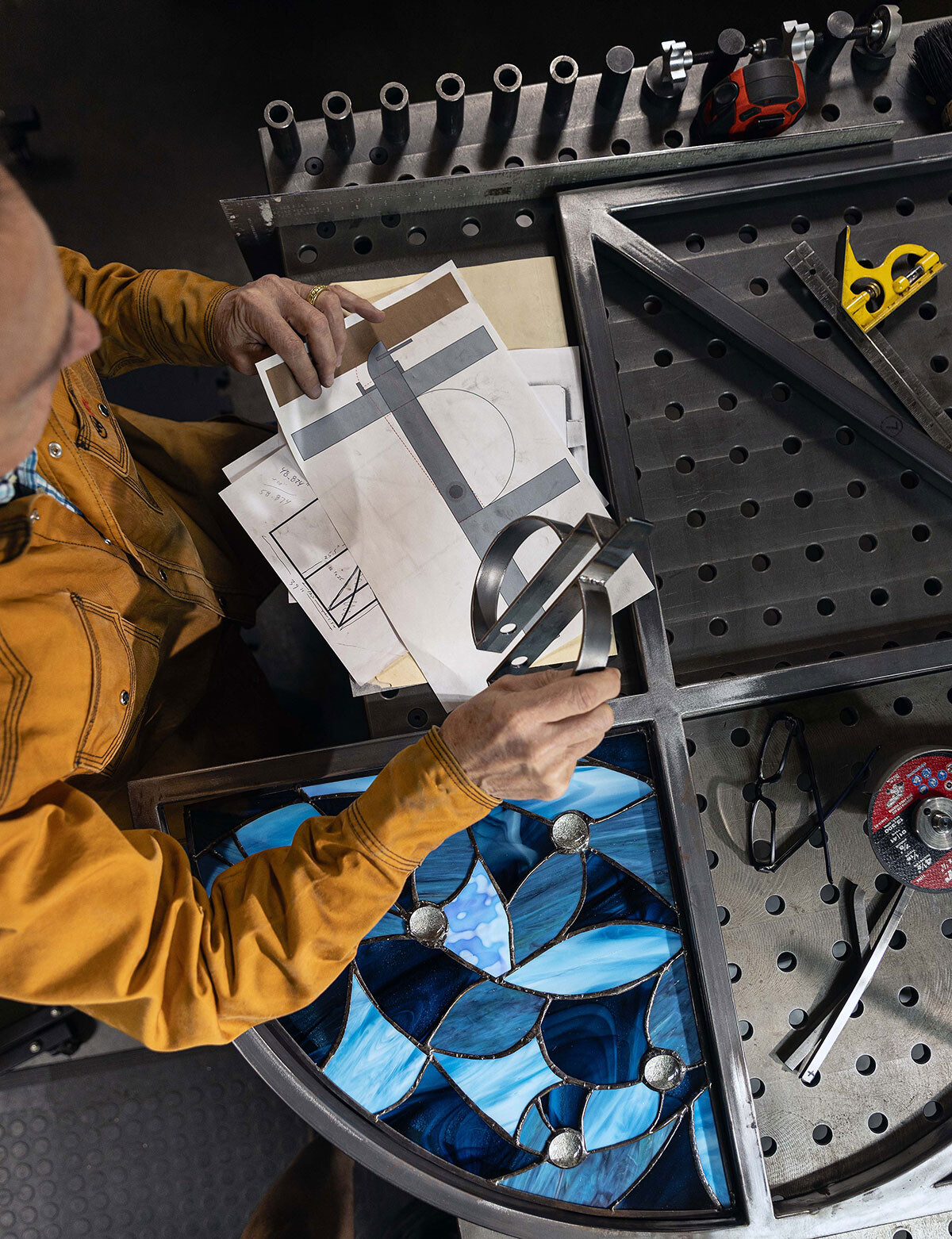
Jeff test-fits a gate handle against his working drawings, beside stained glass made for the same piece.
After working briefly for someone else here, Jeff started Dale Design. For three decades, he says, “If there was a creative opportunity involved, I was all in” — logos, packaging, displays, signage, books, annual reports, the occasional website or ad campaign that came along as a byproduct of client work rather than the point of it.
The space that houses both businesses was constructed 15 years ago at Jeff’s home. The plan was for him to run his design studio upstairs with fabrication happening downstairs.
The woodshop came first. Jeff grew up in his father’s shop. The metal side arrived by accident. A father-son car project (still sitting under a tarp outside) meant acquiring metal fabrication equipment, which meant, eventually, Jeff’s wife’s car got permanently evicted from the garage.
That unplanned metal shop is what allowed a body of sculptural work — some dating back to decades-old sketches — to finally get made. About eight years ago, as Jeff’s kids grew and the design industry moved further online, he started circling back to the fine art he’d set aside when graphic design first found him. “I realized I don’t have the interest in the digital side of things as much as I do the tangible,” he explains.
Walk the gallery space Jeff built above his studio and the vocabulary repeats: a circle here, a square there, a load-bearing triangle somewhere in between. It’s a discipline he traces directly back to his logo work. “If I could design a logo with a piece of type and make it say everything, that was like a home run for me,” he says. “I’m an abstract artist, and I work with some of the simplest of forms — squares, circles, and triangles.”
That restraint shows up across scales and materials. Unbroken, a sculpture of raw wood and steel welded to resemble salvaged shipyard metal, sits on a mirrored base so the piece appears to extend into infinity. Jeff describes it as “a pure celebration of the two materials.”
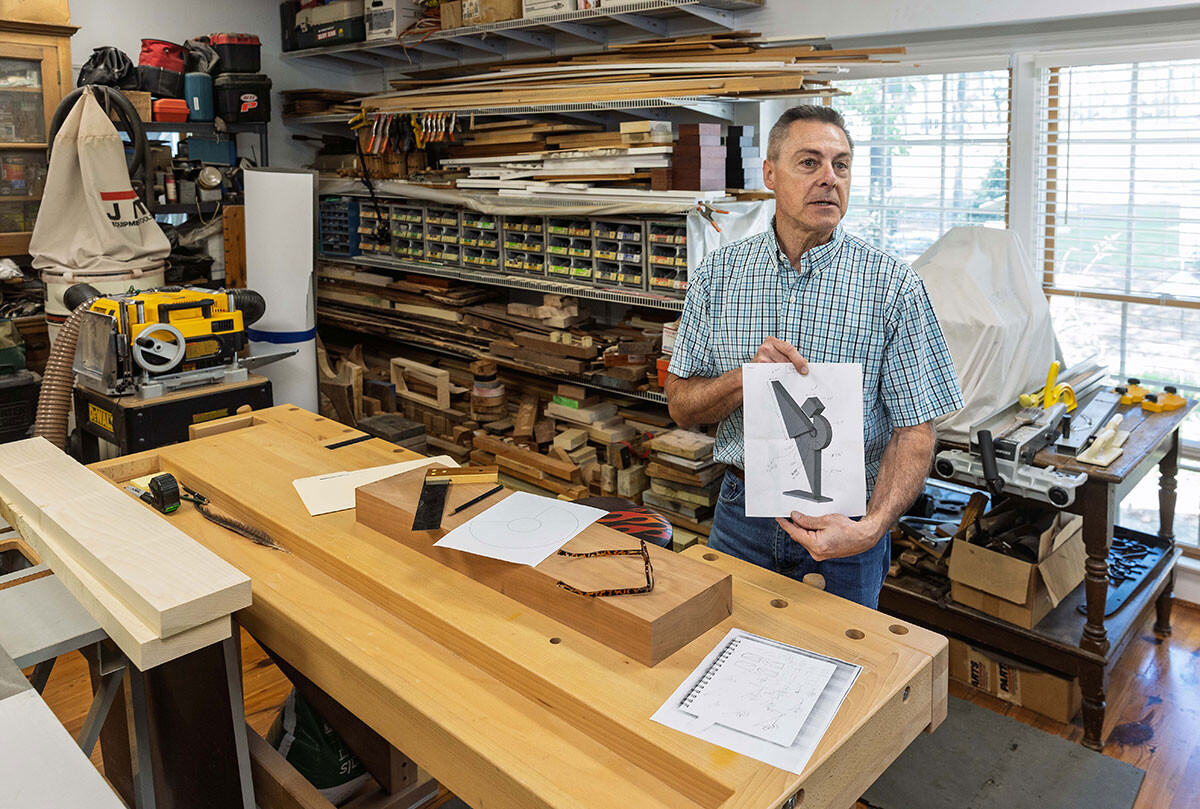
In his wood shop, Jeff holds a digital rendering of a sculpture still in progress.
His Form Over Function chair series, which includes The Talking Chairs and the newer Trinity Chair, started in wood decades ago and is now being reworked in metal simply because Jeff finally has the equipment to do so.
Stroll and its companion piece Dance earned Best in Show at a competition in Hickory. A second, refined version of Stroll later sold at a show at The Centerpiece Gallery in North Raleigh, which has held onto several of his pieces since.
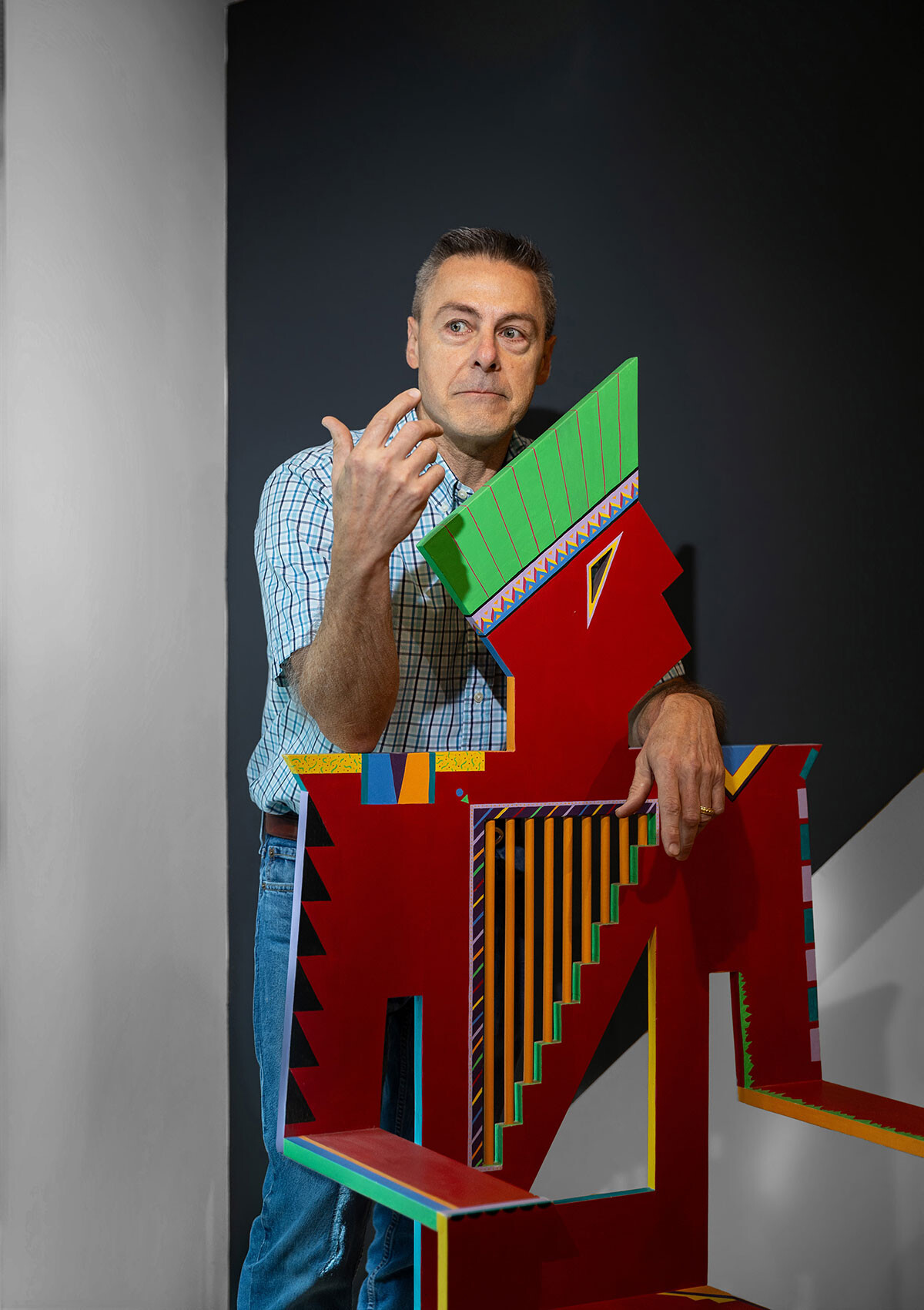
Although it is a different register entirely from his recent work, this patterned chair in enamel red, green, and gold is a similarly architecturally inspired form despite being crafted in 1980.
Jeff’s first public show, years earlier, came from a friend rather than a gallery. Dan Campbell, a local painter Jeff had befriended after designing a Cary Visual Art logo for free, wanted him to exhibit at an auction whose proceeds went to charity. Jeff had been hesitant, feeling he needed a deeper body of work first; Dan pushed anyway.
Behind nearly every completed piece is a stack of sketches. For The Thinker, an homage to Rodin, Jeff filled page after page trying to work out the balance between top and bottom before the shape finally clicked into place.
“I don’t like to do the same thing twice,” he says of his broader approach. Even when he returns to a form he’s used before, he pushes it somewhere new rather than repeating it outright.
Once a sketch holds up, he’ll often build a small study, in wood or 3D print, partly to test an idea that reads well on paper. “When you put it in your hand, it just takes on a different form,” he says.
From there, the design moves into CAD, where he can test scale, work out how much material a piece will require, and send files out for CNC routing or plasma cutting.
He builds small on purpose, testing whether an idea holds before committing to size — because his instincts tend to run the other direction. “A lot of what I design and think up, I envision big,” he says.
Material dictates a lot of that process. Wood, he says, punishes mistakes outright. Metal is more forgiving of error but unforgiving of heat. Increasingly, Jeff works in both at once, plus concrete on occasion, drawn to how differently each material catches light and touch.
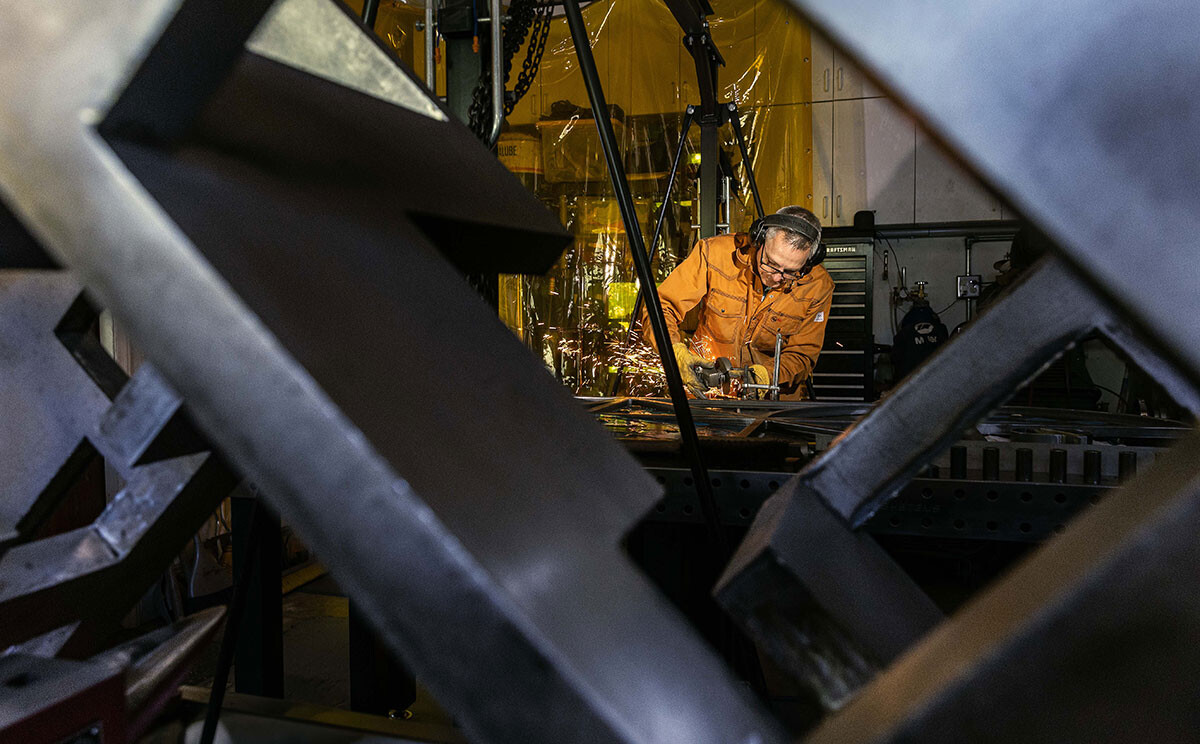
Framed by pieces of a work in progress, Jeff grinds steel in his metal shop.
His influences run in a similarly spare direction: Rodin for form, M.C. Escher for Arbor, the kinetic wind sculpture in his yard, and Keith Haring, whose flattened, high-contrast line work Jeff says he’s always loved.
But the clearest throughline isn’t a sculptor at all; it’s the discipline of a good logo, still doing the job it always did. “I’m trying to express myself, express the statement, express an idea, through simplicity and through basic form,” he says.
Say the most with the least. The medium just changed.
Jeff also thinks deliberately about how pieces work in relation to each other. Placing a small “model study” beside the larger sculpture it led to, he’s noticed, changes how people see both.
“You see a sculpture like Stroll, and it intrigues you,” he says. “You see another sculpture like Dance sitting right next to it, and then your brain starts to see everything in between.”
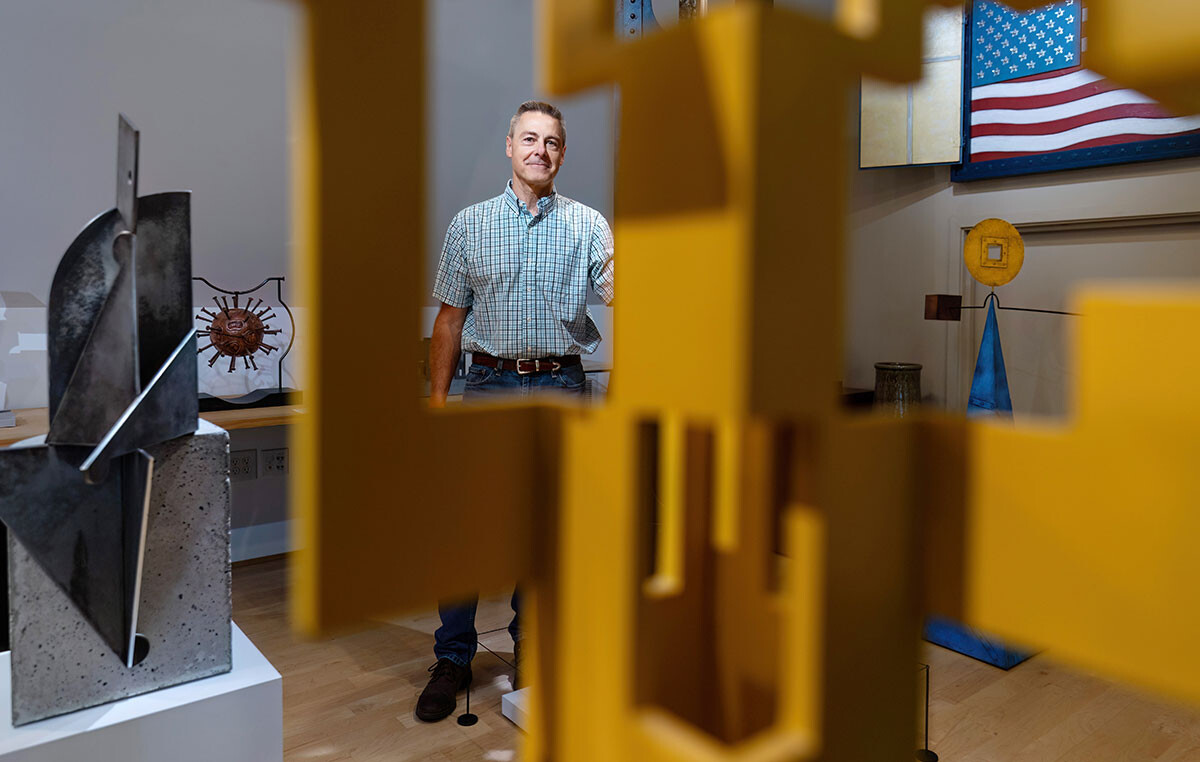
In the home gallery he built above his studio, Jeff is framed by pieces from across his fine and functional art, including, at right, God Bless America, inspired by 9/11.
That connective effect is, he says, part of why he keeps circling back to related forms rather than treating every sculpture as an isolated statement.
Some of Jeff’s most personal work never went up for sale. A piece he calls God Bless America, made from a wood panel salvaged from his own house, carries the faint handprints of his two now-grown children along its edges. It’s a folk-art response to September 11 that arrived, he says, without a single preliminary sketch.
A second piece called Anguish is hand-carved with 20 screaming mouths and pierced by 40 rusted spurs to mark the year 2020 and needs no explanation beyond the pandemic moment it commemorates. “Sometimes there’s pure clarity in what you want to do,” Jeff says. “That happened to be one.”
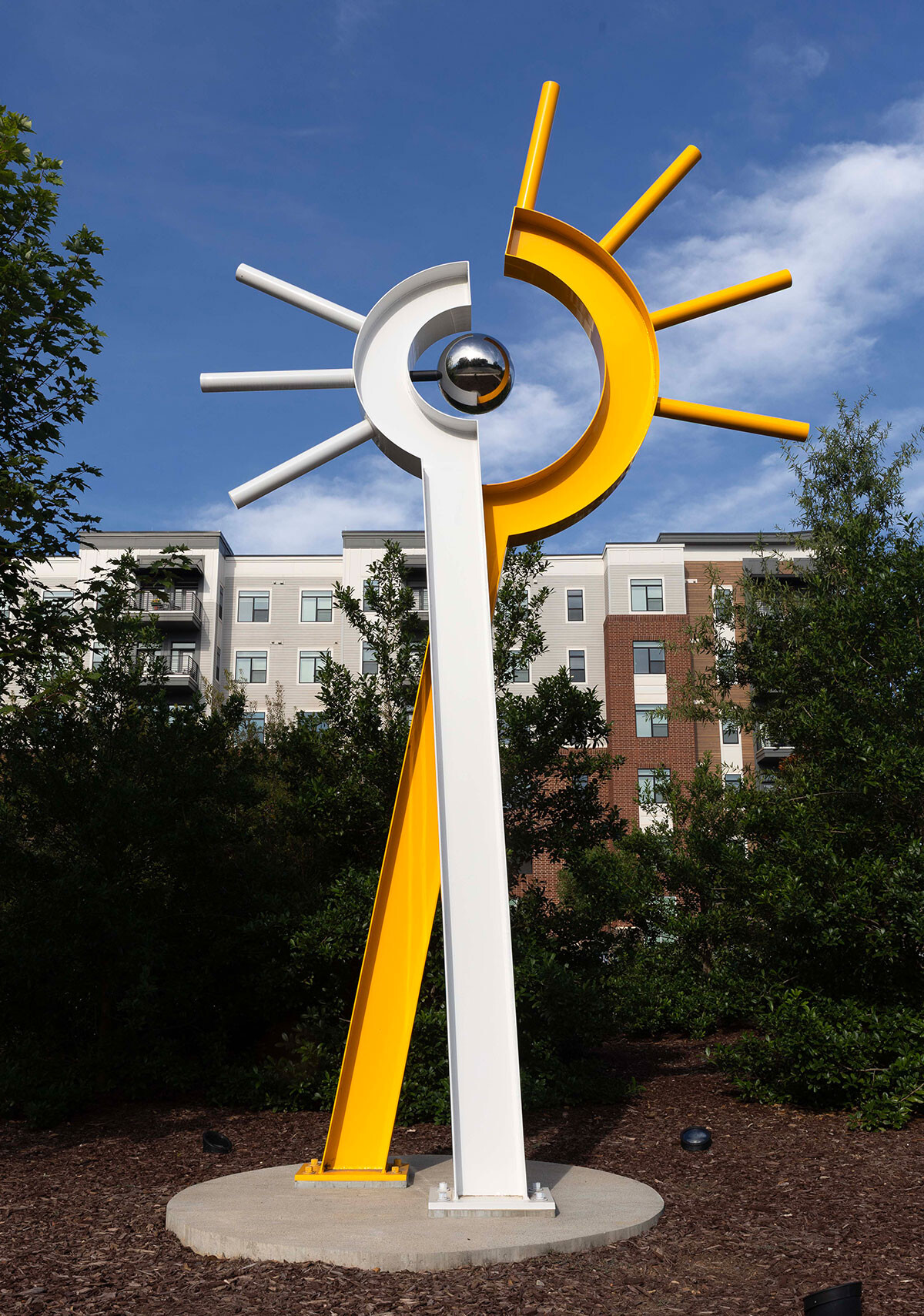
Sunflower is a large-scale steel public sculpture built from I-beams so that from a distance the piece reads as a flower forged from industrial steel.
Elsewhere, his work is meant to be lived in rather than looked at from across a room. He’s built garden gates, railings, credenzas, and tables for clients.
One outdoor table was commissioned twice by the same client, once for a mountain home and once for the backyard left behind. Because Jeff didn’t want to repeat himself, from 20 paces the two tables look identical, but the mix of wood and metal up close is entirely different.
The garden gate he designed and is currently completing folds the same circle-square-triangle logic into wrought steel and stained glass, with an ivy motif and blue-and-green palette chosen in honor of the client’s late wife.
In his own front yard, Arbor spins on ball bearings, opposing shapes checking each other so it never spins away. “I’ve come out here when we’ve had the worst of windstorms,” he says, “thinking it’s going to just spin off, and it, so far, continues to keep itself in check.”
His largest public piece to date, a 16.5-foot steel sculpture titled Sunflower, stands on Kildare Farm Road on the Glenaire property. Built from I-beams, from a distance the whole thing reads as a flower forged from industrial steel.
Another sculpture, once installed in his own backyard, now stands at the entrance to the UNC Surgical Center in Chapel Hill. A smaller version of that same Unbroken design, scaled down to about a foot tall in wood and metal, became a wedding gift for his daughter. The same symbolism, sized for a different kind of permanence.
Jeff wasn’t looking for validation when Sunflower was installed, but he got some anyway. While photographing the finished sculpture one afternoon, he overheard a stranger walking her dog say to no one in particular, “I can’t tell you how much this brightens my day.”
She had no idea the artist was standing right there. “I’m grateful that I get the opportunity to give back in some way,” Jeff says.
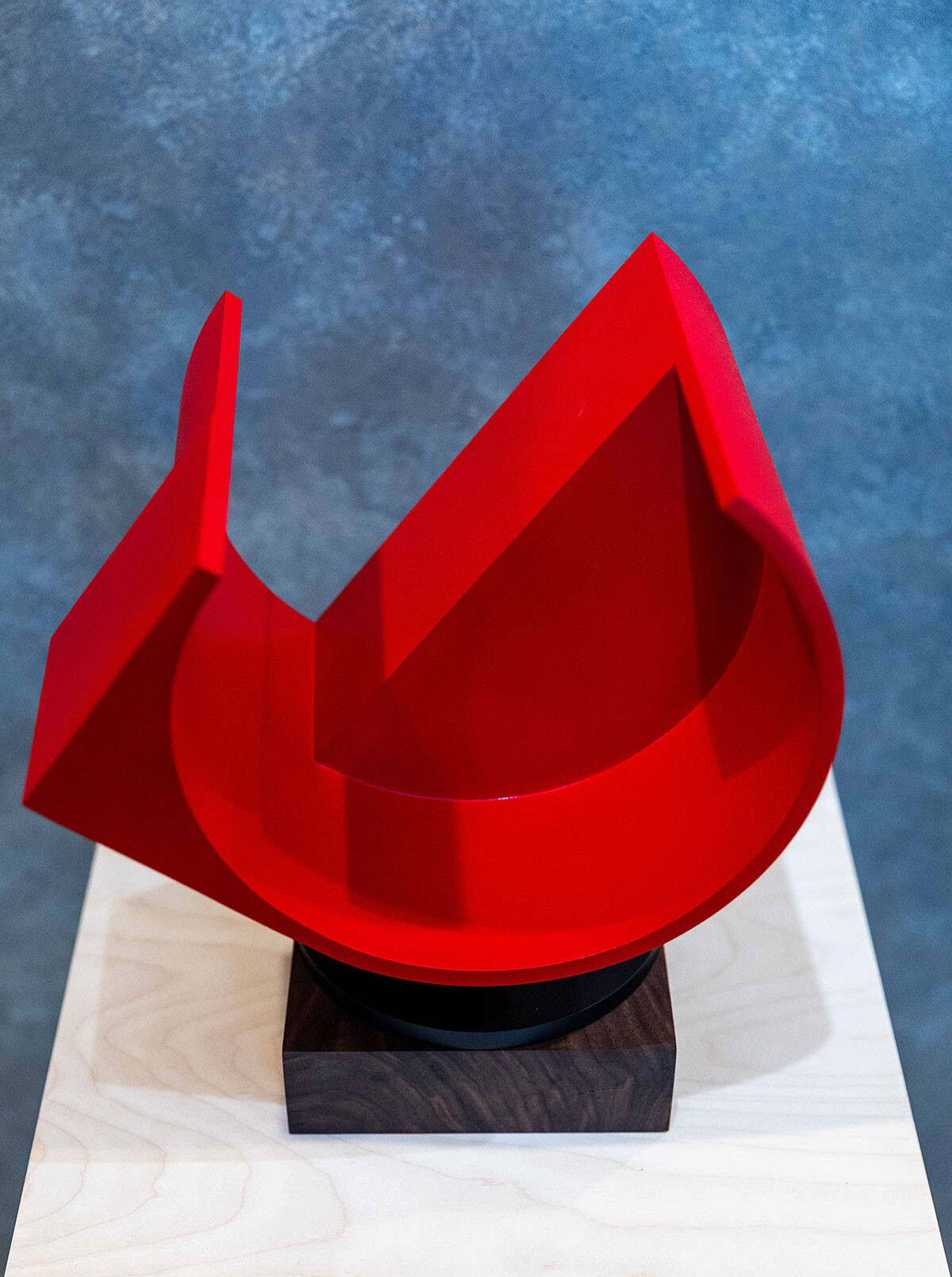
Jeff aims “to express myself through simplicity and through basic form.”
Jeff still does work for select Dale Design clients, some quietly becoming its own tradition. For approximately 15 years, he’s donated design services to an annual golf tournament fundraiser; for the last several years, he’s also fabricated the event’s trophies.
The pull toward scale keeps growing. “If I were greedy,” he says, “I would love to have a big shop that wouldn’t limit me as to what I can explore.”
Museums are on his mind, too, less for the validation than for what they’ve always given him. “The amount of time I’ve spent at museums for pure inspiration,” he explains. “I need to see something that will help me think.” If he had one dream left to chase, he says, it would be to have a piece in a museum setting.
For now, the work keeps stacking up in the shop downstairs — half-finished metal frames waiting on a second wood-and-metal version, a 9-foot sculpture nearly ready to leave the studio, sketches for chairs that haven’t been cut yet.
Jeff isn’t in a hurry to call any of it finished. “I will never say I’ve succeeded,” he says, “because when you do, you’re done.”
Whatever comes next, it will still be circles, squares, and triangles — the same simple forms he once used to say everything a logo needed to say, now saying something that’s entirely his own.
jeffdaleart.com
@jeffdaleart

- Backyard Bliss
- Back in Service
- Garden Adventurer: Tiny Dancers: The Dainty Daffodils
- Recipes from Readers: Almost Pumpkin Butternut Squash Pie
- Liquid Assets: Garden Club Margarita
- Pay It Forward: Loads of Hope
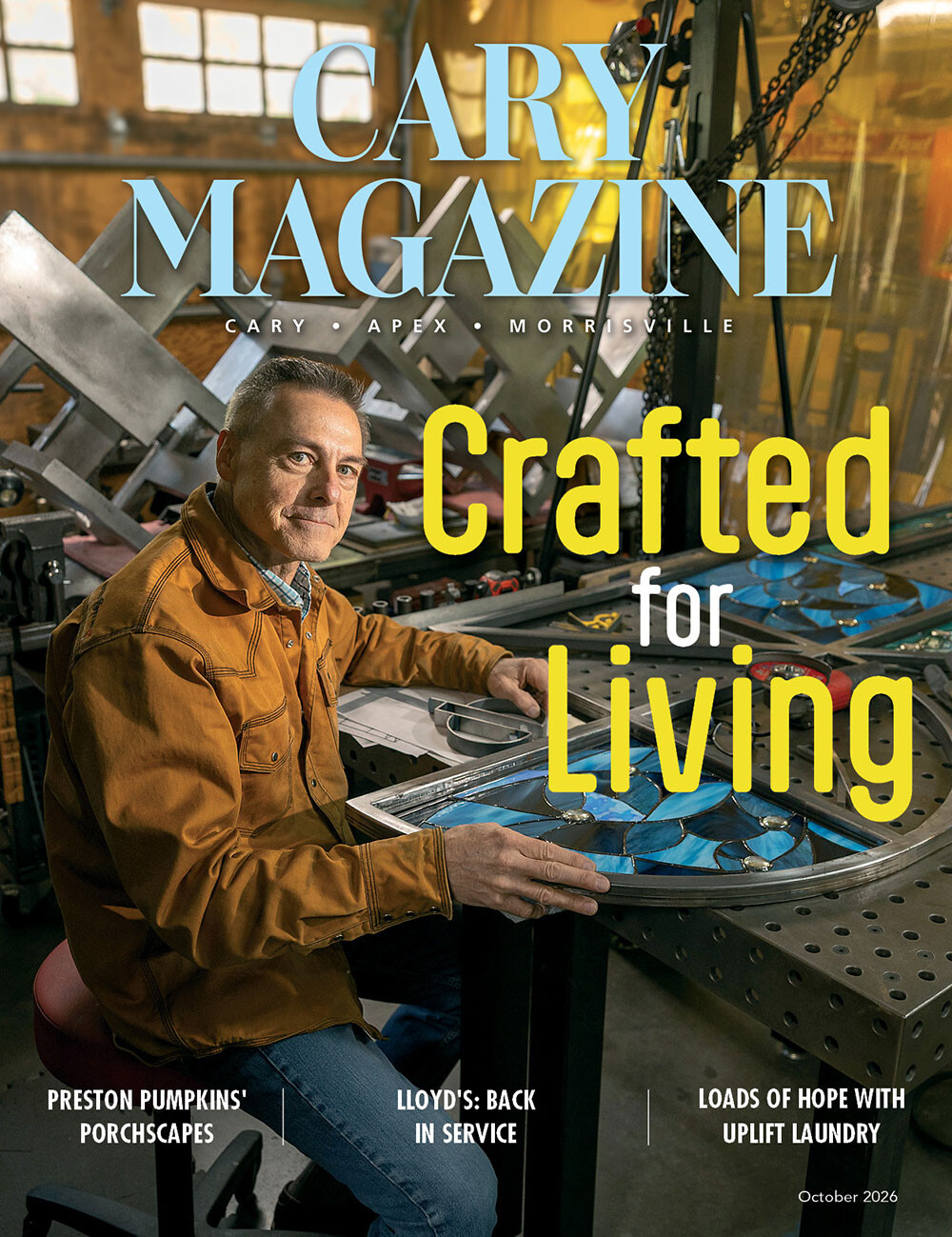
- By Design: The Second Act of Jeff Dale
- One Corner, Three Callings
- Small Business Spotlight: Preston Pumpkins
- Compounded Interest
- Things to Do: October 2026