



Few among us have been able to avoid healthcare inconveniences. Difficulties finding primary care physicians, long waits for appointments, and delayed specialist visits are symptoms of the excellent care quality and booming population in Wake County. According to Senator Gale Adcock, the 66 new residents moving to the area every single day are exacerbating healthcare access pressures.
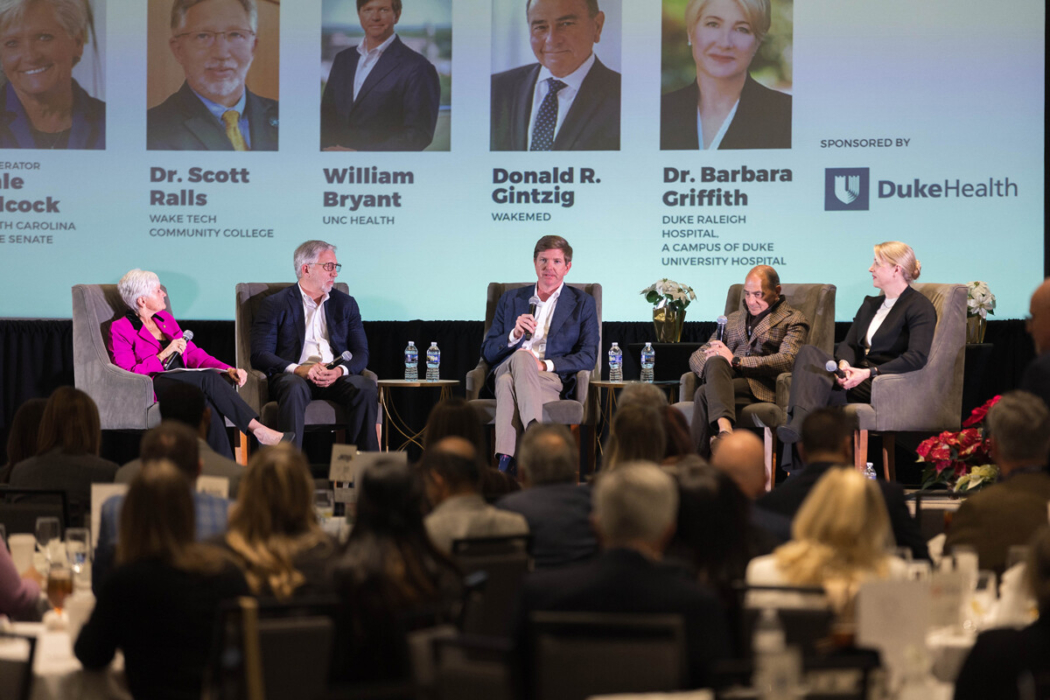
At the recent Wake GPS: Growth + Prosperity Summit, a panel titled “Healthy Growth: Scaling Care for a Thriving Wake County” tackled this challenge head-on. Leaders from UNC Health, WakeMed, and Duke Raleigh Hospital discussed their solutions, including the practical technology being used to solve some of healthcare’s most persistent problems.
Smoothing the “Lumpiness” of Healthcare Access
Healthcare demand is anything but predictable. As William Bryant, Chief Financial Officer of UNC Health, explained, the industry faces “lumpiness” in the timing of patient needs. Flu season clogs emergency rooms, and end-of-year deductibles generate both rushes and delays that challenge the scheduling of surgeries and other consults. This uneven demand creates choke points and long waits for appointments that can be scarce.
To solve this, UNC Health is now using a simple AI tool. When a patient cancels an appointment, the system automatically texts others on the waiting list, offering them the newly opened slot. William shared how this tool personally moved his own dermatology appointment up by a month and a half.
This is an excellent example of an opportunistic, high-impact AI use case. It isn’t a futuristic bot or AI listening to your personal diagnosis, but a practical workflow solution that smooths a process. As the county and state populations continue to grow, reclaiming even a handful of specialist appointments each week has a powerful compounding effect on the community’s well-being.
Specialist Advice Without the Wait
The six-month wait to see a specialist is more than an inconvenience, it poses a serious risk to care. Dr. Barbara Griffith, President of Duke Raleigh Hospital, described a technical solution that helps address this delay: the “e-consult.”
E-consults allow a primary care physician to communicate directly with a specialist over a quick check-in, often while the patient is still in the primary care office. The specialist can offer immediate advice and insights that the primary care doctor can then incorporate into the treatment plan. This process shift allows specialists to empower primary care physicians, rather than being the obstacle to the next phase of treatment. For the patient, it fundamentally changes the journey from a passive waiting game to active improvements, while saving months of waiting and extra appointments.
“That really can make a difference in terms of the efficiency of getting the right care to the right people without relying on those traditional models,” said Barbara.
The Surprising Wisdom of Legislative Patience
The panel was ably moderated by Senator Gale Adcock, who is also a former nurse practitioner.
When asked about the legislature’s role in healthcare technology, Gale took a less-is-more approach, arguing that the legislature’s best course of action is to adhere to the medical mantra “do no harm” and “not act prematurely.” With only two healthcare professionals among 50 state senators, Adcock explained that passing laws without a deep understanding could “tie the hands of our hospitals and educators and clinicians.” She made the case instead for a more collaborative approach where lawmakers allow the industry to innovate and identify specific needs or potential loopholes before stepping in to craft thoughtful, effective regulation.
For her part, Adcock was most enthusiastic to hear “new ways of thinking about old ways of giving care. In particular, Adcock was a fan of keeping patients at home when possible.
“Not everybody needs to be in a hospital to actually do well, and often they do much better at home, in particular older people,” Gale said after the session. “That willingness to think outside the box, I think that was exciting to me as well.”
The Hospital of the Future Isn’t a Building
The future of healthcare access in Wake County isn’t waiting for a new hospital wing to be built; it’s being coded, automated, and shared today. Barbara pointed to the use of Electronic Medical Records as an example. EMRs are by no means a new technology, but they continue to represent a foundational solution for improved continuity of care. These tools enhance the quality and safety of patient experiences while enabling quicker interactions as they transition between providers.
And ultimately, it is these tools that will “save” Wake County from the continued pressures of exponential growth. The discussions at the Wake GPS Summit revealed that the most impactful advancements are not futuristic hypotheticals, but practical — and often simple — tools that follow the patient. Models of healthcare may change, but as long as we continue to facilitate information sharing across systems and providers, the patients will continue to benefit.