



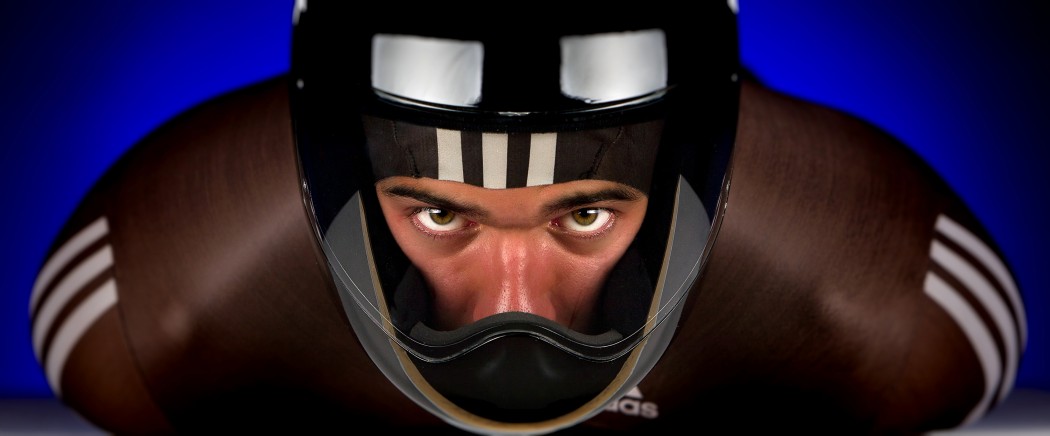
Imagine an Olympic hopeful from Cary, training four hours a day in the weight room or on the track. Chris Hoina is that athlete, but his sport of choice isn’t what you might expect from a former competitive mountain biker from central North Carolina.
Hoina hopes to compete in the 2014 and 2018 Olympic Games in skeleton, the winter sport in which athletes sled head-first down a mile-long frozen track in less than a minute.
For a sport like that, you might imagine him determined to bring home Olympic gold from a young age and training on his sled for years on end. Not Hoina.
Just before the last Winter Olympics rolled around in 2010, he wanted to brush up on the gamut of sports included in the games. As he read about the events, Hoina found himself intrigued by bobsled, but weight requirements were too heavy for his lean frame, so he focused his attention on the skeleton and decided to fill out an application to try out for the sport.
Without the athletic background of a traditional skeleton slider, Hoina had some skills to polish. Though he’d never sprinted competitively, the Olympic development form asked for sprint times. Bending the rules a bit, “I sort of ‘predicted’ where I thought I was going to be,” he admitted.
He hit training head-on to prepare for the combine test for new athletes, but when he pulled his hamstring in sprint training he realized he needed more education to reach his goals without injury.
Hoina found a speed camp at Cary’s Athletic Lab teaching the basics of sprinting mechanics. While it was exactly what he needed, he was a bit out of place.
“I was 26 or 27 and the mean age was about 11,” he said.
As if by fortune, the coach of the sprint camp was Mike Young, PhD, a nationally renowned athletic development expert who had himself trained on the skeleton development team.
“What are the chances that I find this guy who’s a doctor, who’s living five minutes away from my house, who did the same thing that I’m trying to do, and is one of the most qualified guys in the country, hands down?” Hoina asked.
After the camp, Young invited Hoina to join the Human Performance Consulting Elite team to train with other world-class athletes competing at professional levels. After months of grueling training, Hoina tried out for the Skeleton Olympic National Development Team, and made the cut.
When he’s not training in the gym in Cary, the former Air Force Survival, Evasion, Resistance and Escape specialist spends time at the Olympic Sports Complex in Lake Placid, N.Y., one of only two skeleton tracks in the United States.
Hoina’s first run on the icy track in September 2010 wasn’t what he expected.
“I got off the sled and I almost didn’t want anybody to look me in the eyes or ask me how it was,” he said. “It felt anticlimactic.”
After skydiving with the military and competitive mountain biking, Hoina admits his adrenaline bar may have been set too high. However, “I’m not an adrenaline junkie,” he said. “I don’t do stupid things for fun.”
In his first skeleton season, he didn’t have the funds to purchase his own sled, so was instead using a rental “jalopy” that he dubbed Loch Ness.
“I was on a sled that predated me,” he noted. But even so, he was a natural.
“I was beating guys who were on their own sleds,” he said — and that’s no small feat.
 With 14 tracks currently around the world, it’s impossible to train at all of them, but the ability to adapt to different tracks is critical. So while Hoina can’t visit the tracks in person, he does the next best thing, utilizing helmet cam videos that other sliders have recorded from international runs.
“I’ll put my laptop on a chair, put my helmet on and lay on the bed and go through the motions,” he said. He might look silly, but he’s used to that from his regular workouts that he describes as “like a circus show.”
The thing Hoina stresses most about his training is his dedication to being the best.
“I think the misperception of a lot of professional athletes is that they’re just big kids who never grew up,” he said.
But he insists he’s not that way, sacrificing much of his social life to the demands of his sport. You’ll find him in the gym on weekends and holidays, and he doesn’t take vacation.
“Training comes first, regardless. That’s your life,” he believes.
While Hoina works part time as a personal trainer, he relies on the support of donors, either directly or via the USA Bobsled and Skeleton Training Fund, to continue working toward his Olympic goal. He still admittedly feels like “a nobody” in the sports world, but he’s immensely thankful for all the business and individual donors who have believed in him so far.
“If communities don’t support their athletes, then sports die,” he said.
For more information on Hoina’s pursuit of the Olympic Games, visit his blog at www.chrishoina.com.